

Back in the day, I helped a global media conglomerate try to consolidate its technology infrastructure. I heard a fascinating story about one of the company’s studio heads (who, incidentally, cared a lot more about who owned which server than he should have). His assistant would dial into every call he did and take notes – so he could send this mogul a memo summarizing the day and keep records tracking all the mogul’s interactions with every auteur.
“Wow,” I thought at the time, “that must be so helpful.” It was real CEO-level stuff. Even very successful executives, bankers, lawyers and other professionals would not warrant that level of administrative support.
Previously I hypothesized here that senior knowledge workers would become Winston Churchill and junior knowledge workers would become strats. I would like to revise that hypothesis. We all will become strats (in that AI-enabled tools will allow us to at least prototype our ideas) and we all will become Winston Churchill, in that agentic tools will provide us with a level of support only available previously to those at the apex of the professional pyramid.
This issue’s main argument seeks to explain - What flow is and why it’s so important both in terms of meaning and productivity - How psychic entropy destroys flow and makes work more frustrating for all of us - How agentic tools can automate the toil required to mitigate psychic entropy
Initial Thoughts
Two ideas crossed my path this week that might become future articles:
How bottlenecks will delay either the AI apocalypse or apotheosis (or both)
The multiple archetypes of infrastructure heads and which ones might be most relevant now
Maybe the AI apocalypse won’t happen this year?
Nobody should comment on the intersection of AI and job loss without having taken Professor Litchfield’s class on “The Industrial Revolution Early Modern England.” Those of us who did learned that Parliament made destroying machinery a capital offense (via the Frame-Breaking Act of 1812) to deter artisans inspired by Ned Ludd. Two decades later agricultural workers rioted against mechanical threshers under the banner of Captain Swing. Mechanization has progressed past weaving and threshing machines, and the UK workforce is still rather bigger than it was in 1830.
The former head of a lifestyle brand warned of a massive disruption to white collar industries. Bloody hell white collar work needs some disruption. We should be embarrassed by the way we do business. There will be dislocation and political backlash, but change will take time. Embedded AI into white collar workflows takes more than buying a threshing machine.
James Pethokoukis makes this point in Vox. He says: there is a long road from demo to deployment; the slowest sector sets the speed limit – and there are many physical and legal bottlenecks AI will not quickly remove. Constraints matter.[2]
Think of flying from New York to Chicago. Maybe you spend
30 minutes getting to LGA
30 minutes getting to the gate
30 minutes boarding
30 minutes on the tarmac
20 minutes on ascent
90 minutes in level flight transiting the 890 miles to Chicago
60 minutes circling ORD
20 minutes on descent
20 minutes de-planing
30 minutes getting to the cab
An hour getting downtown in traffic
Seven hours door-to-door. Let’s say someone invents a plane with a Mach 8 cruising altitude. Your plane could get you from NY to Chicago airspace in 10 minutes – reducing your total trip from seven hours to five hours and forty minutes. That’s enterprise AI, at least in the short term. So let’s get to work. As today’s main argument points out, there is endless complexity and toil to address in applying AI in large, complicated organizations.
A typology of infrastructure heads
I’ve met a great many executives who have run large enterprise technology infrastructure shops. When a CIO asked me last week what makes a great infrastructure head, I resisted replying, “It depends.” Cliche is bad. Instead, I observed I have seen three types of infrastructure head based on how they grew up professionally:
The classic infrastructure head is an operator. He started out as a sys admin or, in some cases, on the night shift in the command center. They derive satisfaction from the team closing tickets. They have strong views about the right way and the wrong approach to incident management, release management and change control. They often manage cost fanatically. They consider all infrastructure operators across every enterprise united against their common enemy, application developers. One I knew refused to use the term “developer.” He said “ax murderer.” [1]
More infrastructure heads now grew up in the engineering organization. They cut their teeth scripting VMWare provisioning and seek to standardize and automate infrastructure enough to replace unplanned work (responding to tickets) with planned work (engineering standard products). Some consider incident management and release management boring details when they can’t be automated. They hate that costs sometimes constrain their ambitions. They consider infrastructure engineers everywhere united against their common enemy, application developers.
A few infrastructure heads are transparent application development leads. At some point their CIO became exasperated by the conflict between application development and infrastructure and reasoned that a developer running infrastructure would at least understand his customers. Servers, circuits, OS instances — they are relieved to have something more tangible than story points to count. These infrastructure heads have a copy of AntiPatterns: Refactoring Software, Architectures, and Projects in Crisis on their credenza. When they listen to the infrastructure operators and engineers, it can go pretty well. When they don’t, it doesn’t.
I’ve seen executives of all three types succeed and fail in running large infrastructure shops, but the world is changing. Companies need to scale AI professionally – with security, resiliency, performance and compliance. I suspect, in many cases, application developers and (especially) infrastructure engineers will have an advantage over the classic infrastructure operator at this moment. CIOs will need heads of infrastructure that will run toward the future with them.
The Main Argument: Using agents to reduce psychic entropy
What you need to know: Flow supercharges productivity and meaning at work – when we say 10x engineer, we mean engineer in flow state – but psychic entropy destroys flow
What you need to do: Use agents to automate to automate the yak shaving (both by your engineers and by your business users) required to keep psychic entropy at bay
What you need to decide: What platforms and guardrails will allow you to help your users create agentic workers at scale, with resiliency, security, performance and compliance
I experienced a remarkable phenomenon when I used to write code for money in my early 20s. I would sit down at my desk after lunch, start attacking a problem (like how to manage large numbers of UI hotspots without degrading performance) and, for want of a better term, woke up 9 hours later to an empty office.
This happened frequently enough that I developed a re-entry routine. First I remember my name, then what year it was and what I had been doing when I went under. Invariably I found that I had made more progress that I ever would have expected with the problem at hand. Then I got in my Nissan Sentra and drove home to Somerville, MA. [3]
Flow state makes you more complex and more productive
Psychologist Mihaly Csikszentmihalyi studied optimal experience. When people report being fully absorbed, energized, and deeply satisfied by what they’re doing they achieve flow. Flow occurs when you have a well-defined goal, where the challenge matches your skill level and receive clear, immediate feedback. The boundary between you and the task dissolves. Time distorts. Self-consciousness fades. Athletes call it being “in the zone.” Musicians and surgeons and programmers all describe the same phenomenon.
Ted Williams may not have been able to count the seams on a Major League fastball, but when he described seeing which way the pitch was spinning, he was talking about flow state. When we say “10x engineer,” we mean “engineer in flow state.” Video games are so addictive because their producers design them to create flow. [4]
Flow is not relaxation. It requires effort and concentration, but it feels effortless. Attention becomes total, leaving no room for worry, doubt, or distraction. People report their highest levels of satisfaction not during leisure, but during flow — even when the work is difficult.
Csikszentmihalyi defined flow as not merely pleasant but transformative. Every time you enter flow, you become a more complex human being. You integrate new skills, new knowledge, new aspects of yourself. Complexity, in his usage, is not about being complicated — it’s about being differentiated (having many distinct capabilities) and integrated (having those capabilities work together). Flow creates growth.
fMRI research has identified neural signatures of flow, including heightened activity in the right anterior insula — a region involved in interoceptive awareness and coordinating task engagement. A 2025 study found that “learning progress” — the sense that you are making headway on a problem — correlates with enhanced proactive brain preparation and improved feedback processing. Perhaps evolution has wired the brain to reward the experience of getting better at something.
When attention is total, you don’t waste cycles switching contexts or recovering from interruptions. You notice new connections and solve problems you wouldn’t otherwise. Flow triggers a cocktail of dopamine, norepinephrine, endorphins, anandamide, and serotonin — the five most potent performance-enhancing chemicals the brain produces. Your pattern recognition improves. Your lateral thinking improves. Your learning rate improves. You want to keep going. A meta-analysis of 22 studies found that flow improves performance across a range of tasks.
People ask me how and why I write so much recently. I thought I had left the ability to get into flow state frequently back in my twenties. In the past couple of years, I’ve found writing puts me in flow state. I go to the coffee shop at 8 am Sunday morning, and look up to find out it’s noon and that I’ve completed most of an essay. For me writing is productive and addictive.
Psychic entropy kills flow
Psychic entropy is the enemy of flow — it implies distraction, anxiety, or confusion caused by conflicting goals, overwhelming demands, lack of clear objectives, or excessive complexity. You try to concentrate but your mind keeps darting to the email you haven’t answered, the meeting that went badly and the vague sense that you’re supposed to be doing something else.
Flow requires all of your attention pointed in one direction. Psychic entropy scatters attention across many directions at once. When I read Csikszentmihalyi’s book, I realized: - I am especially sensitive to psychic entropy. It drives me nuts. I loved the concept of mutually exclusive, collectively exhaustive because it reduces psychic entropy. [5] - My professional life is a festival of psychic entropy: people, meetings and documents flying at me from every direction - I sometimes make myself a less inspiring leader by externalizing psychic entropy – forwarding on the email and implicitly saying “you go figure this mess out, because I don’t want to”
So I started a multi-year, doomed campaign to reduce psychic entropy, trying a succession of second-brain type tools. Everything failed. Why? I’m not good at process, and most other people aren’t either. Engineers don’t like yak shaving and nobody else does either. Sales executives don’t like entering their pipelines into a CRM tool. And I was just hopeless at remembering to enter the notes about a meeting in the correct place. What information technology did I wind up using to fight psychic entropy? A 10x7 spiral notebook. [6]
Maybe AI kills psychic entropy
And then my colleague Sven Blumberg encouraged me to try Cursor – I started to use it in conjunction with Obsidian – and it helped. I created templates and folders for people, companies, proposals, engagements, documents and tasks, with links between each of these things. I even downloaded years of donations to Brown-RISD Hillel and dropped each one into a donations folder.
More and more, I found myself using the Agent window rather than the Obsidian GUI to enter and retrieve information. Just typing “Jane Schnoggs is the CIO of Amalgamated Socks and Hosiery. She is located in Atlanta” is a lot faster than tabbing through fields. Data warehouse Evangelists used to invoke the million dollar query to justify big investments. Asking “There’s a BU CIO at Global Otter Supply named Mike or Mark – what’s his last name” may not be a million dollar query, but getting an answer reduces my psychic entropy a lot. Also, when I make a wrong turn in structuring a template, Cursor can remediate the problem with one prompt. Path dependence becomes a much lighter burden.
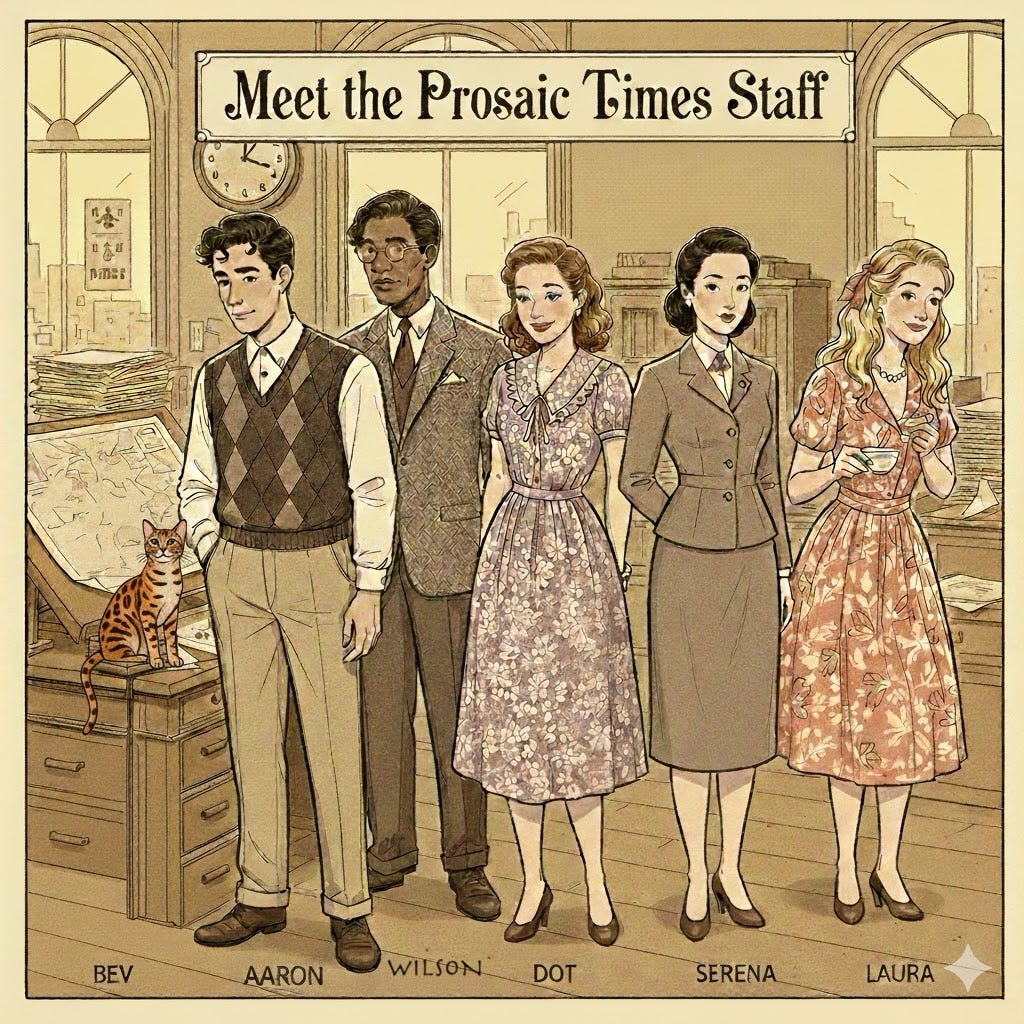
I realized I could push this a lot further, so I set up an agentic workforce for Prosaic Enterprises [7]
Dot, the chief operating officer, whose favorite expression is ship shape and Bristol fashion, now that I’ve taught her how to use it correctly
Wilson, my research assistant
Serena, who manages the Technology Leadership Forum
Laura, managing editor for the Tech Office Update and Prosaic Times
Aaron, board secretary for Brown-RISD Hillel
Bev, the office cat, who gets into everything [8]
Yes this amuses me. It also reduces the context that any one agent has to master and retain. And I can have different agents pursuing different tasks at the same time.
Dot is already organizing all my notes and starting to understand my calendar. Wilson will be a journey. Even with a detailed system prompt Wilson still writes like a management consultant. Sometimes he cites sources without reading the article. I had to admonish him to avoid this. (In fairness, I’ve had to do the same with many associates over the years.) I ask him to compare every bit of guidance I give him to his recent actions and either update his system prompt or create a skill based on that. I’m also feeding him thoughts for an upcoming piece on enterprise technology and epistemology. We’ll see how this progresses.
In contrast Serena has been a revelation, even after a few days. Twice per year my colleagues and I convene 50-60 CIOs, CTOs, CISOs and the like to get into, well, the stuff I talk about in Prosaic Times. I’m fanatical about the experience: senior folks, open dialog, Chatham House rules and not too much slide-ware. I tell my colleagues: there are senior executives; they know we will come present to them whenever they like. Today they will be in a room with 50 folks wrestling with the same problems they do – they’ll want to speak to each other.
Some of my colleagues have asked me how TLF came to pass. List management. A gazillion copy-paste operations built TLF. Me sitting in the coffee shop on weekend mornings, scrutinizing my address book, my LinkedIn connections, client lists and sending emails to CST members. It’s painful, and Outlook templates only help so much.
Tracking all this across a multi-step, multi-path invitation pipeline is brutal. Generations of associates (who probably hacked off somebody in a past life) have wrestled with a spreadsheet that has grown to, like, a million columns. Can a data store be negative Normal Form?
When I sicced Serena on this, she ripped through this spreadsheet (and a few ancillary ones) and put a markdown file for everyone in my People folder – and assigned them a TLF_status value in the YAML front matter. Dot and I created skills for her to execute on when we ask a McKinsey colleague to invite someone from his client, when the invite goes out, when the invitee responds. I just copy an email I am cc’d on into the agent window and Serena does the rest.
Trying to figure “who are the people at Pharma companies we’ve invited to join TLF but haven’t responded to the invite yet?” has been a giant pain in the neck involving much scrolling and manipulation of dropdown boxes. Now I just type a sentence. Serena has reduced the yak shaving and the psychic entropy associated with TLF for me by ninety percent. In 96 hours.
Imagine how transformative this could be for a real company in any one of a dozen sectors that does B2B sales?
Scaling is the hardest part
I like to say: technology is easy; technology at scale, with resiliency, security, performance and compliance is hard. You could say I’ve only done the easy bit.
Serena lives on my computer – she can’t help anyone else without my intermediation. I am sure this will create some new frustrations. Ideally, Serena will live on the McKinsey cloud, so she can help others. This raises more questions - What’s the governance here? How do we decide what’s a personal agent, a workgroup agent and an enterprise agent? - What’s the architecture here? Does my experience working with Serena degrade if she’s no longer tightly linked into my Cursor environment? - How do we think about access right? Only a few people have access to the old TLF spreadsheet. Should only those people interact with Serena? Or would we want to allow a partner on the team serving Galactic Pet Food to ask, “Has anyone from my client been invited to join TLF? How many members are part of the pet food industry?”
Agents could make work more meaningful
At its best work provides meaning. It produces outputs others value. It stimulates growth and learning in the worker. The toil we all engage in to keep psychic entropy at bay just enough to get some meaningful work done provides no meaning. It is theft of our time. It is theft of the value we might create.
Matt Shumer is wrong and James Pethokoukis is right. Maybe something big is happening, but it could make work more productive and less painful for all of us. It might reduce what toil steals from us. My recent experiments (and they are experiments) are encouraging. But systematizing and scaling the creative application of AI will be essential. There will be many constraints and bottlenecks. So CIOs, CTOs (hi, Sven!) and heads of infrastructure must run toward the future here. Will you? Will your team?
Footnotes
[1] Speaker of House of Representatives Sam Rayburn famously said “The Republicans are the opposition; the Senate is the enemy.” Like that. No he probably didn’t originate the phrase – maybe that was “Czar” Thomas Bracket Reed.
[2] You even need to think about constraints in college daily newspaper production processes. Also everyone should read The Goal. If the Phoenix Project is Apocalypse Now, The Goal is Heart of Darkness. If you loved the Phoenix Project, check out this blog entry about the authors used The Goal as the pattern.
[3] I lived with three housemates, one Harvard Math PhD candidate, one MIT Math PhD candidate and a BA at Mercer who had graduated from MIT in three years. I was the house meathead. Compared to Harvard, MIT and Mercer I was Joey Tribbiani, but, on the other hand, I had a girlfriend and a car. Some recollections (at least the more decorous ones) from that era in my life:
I claimed to be running an experiment in graduate Math education. Harvard sought to learn math by going to math classes, reading math books and doing math problem sets. MIT spent his time watching Star Trek: The Next Generation and seeking to super-saturate Tang. They both passed their qualifying exams, so I declared the experiment a success.
Wall Street started to get really excited about quantitative finance in this era. I would pick up the phone. The nice woman on the other end would say “This is Jane Doe from Goldman Sachs’ recruiting department. Could MIT come to the phone?” I would shout, “MIT, do you want to speak to Goldman about a job there.” MIT would reply, “Can’t now. Watching Star Trek.” This went on for months. Very demoralizing for those of us waiting to hear whether we got into business school.
Harvard and MIT were not paragons of fashion. One day I came home from work. Having had a proposal meeting, I sported a navy blue suit, white button shirt and striped tie. MIT saw me and quipped, “Oh, I’m sorry. The people who wanted to buy the mainframe live next door.”
My girlfriend at the time was a law student. When she spent the weekend, she would often do her homework at the dining table and leave it there when she went to sleep. Harvard and MIT would read it early the next morning and leave her little notes about where they perceived her thought to deviate from formal logic. They believed they were being helpful. I did not support this dynamic.
Did my mother, of blessed memory, used to say “You know, that house you lived in in Somerville reminds me of the show on CBS with the scientists?” You know that she did.
[4] Video gaming is a USD 200B industry designed around flow. Imagine if we could bring that level of engagement to office work – or education?
[5] I used to organize and reorganize my bedroom as a kid. Today, I like to say that I can’t impose order on planet Earth, but I can impose order on the utility closet in my study.
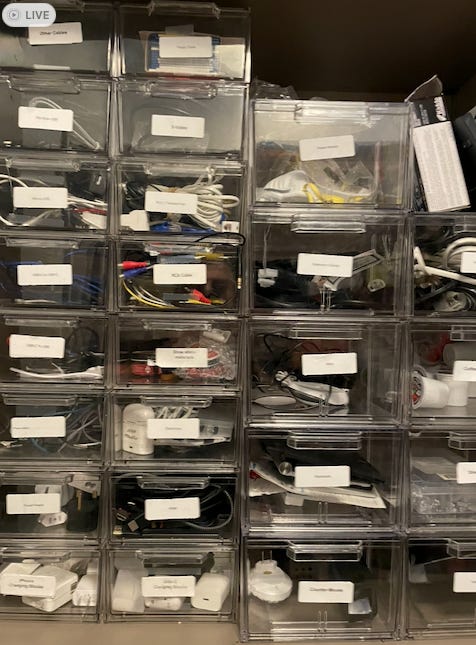
How many times have I reorganized the woodworking shop in my garage in Rhode Island? Many, many times.

Noting my affinity for sticking printed labels on boxes, Amy says I am an order muppet, while she is a chaos muppet. If you’re not familiar with the order muppet-chaos muppet dichotomy you should be. It’s one of the most important psychological concepts of the 21st century.

[6] But what a spiral notebook it is. If the people who designed first generation Acura NSX or the FD RX-7 made spiral notebooks, they would make Maruman Mnemosyne notebooks.
[7] I haven’t set up an agentic workforce in Claude Code to help engineer the enterprise technology economic model. When I do, they will all be otters.
[8] I told Amy that at some point in the future she might email Dot, rather than Suzy, for certain logistical information. She replied, “If I’m not going to email Suzy, I’ll probably just email Bev.” One more modality to design a solution for.
Hey James thanks for sharing this I love your writings I need to ask If tools like Serena eliminate the 'yak shaving' that typically forces us to internalize a system’s physics, how do we prevent 'vibe coding' from scaling architectural fragility?
Really interesting piece. The framing of psychic entropy versus flow really stuck with me, especially that so much “productivity” is just context management in disguise.
Curious to see how reproducible those gains are across different kinds of work, but the focus on minimizing context switching feels right.