

Have you ever read “The Lonely Crowd” by David Reisman?
1. It’s astonishing. Again and again, I double checked the publication date. I couldn’t believe that a book from 1950 could so insightfully describe American political and cultural dynamics seventy-five years later. Reisman was decades ahead of his time, describing changes related to a post-industrial, low population growth economy that wouldn’t fully mature until the 21st century.
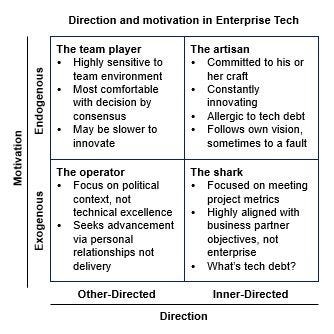
2. I picked it up because I thought over the past decade or so I had move from being other-directed to inner-directed. That’s not so -- I have always been inner-directed. I changed from being exogenously motivated to endogenously motivated.
3. Reisman hypothesized:
- Tradition-directed people (guided by long-standing social norms) dominate pre-industrial cultures.
- Inner-directed people (guided by internal gyroscopes set early in life) dominate industrial cultures.
- Other-directed people (who develop sensitive radar to align themselves with peers) dominate post-industrial cultures.
4. This is orthogonal to exogenous versus endogenous motivation. And inner-directed person can be motived by external markers or success like titles and salaries or internal markers of success like knowledge or excellence in craft.
5. Reisman explained that economies shifted from building factories to, for example, consumer marketing would selected for other-directed personalities (focused on influencing other people) -- even though other-directed cultures might be more anxious, less innovative and more risk averse.
6. This has some fascinating implications for enterprise tech
- Tech historically has drawn inner-directed people -- folks excited at an early age by bending computers to their will
- Tech has a long history of attracting idealists -- people committed to using technology to change the world or committed to elegant solutions, rather than getting the next promotion
- Even for 10xers, the age of the heroic, lone programmer is long gone -- big things require teams of architects and engineers collaborating together
7. I suspect you would want to build a Tech organization oriented toward
- Inner-directed people with endogenous motivation
- Who are conscious enough about their inner-direction to use part of the other-directed toolset -- understanding others’ motivations and allowing themselves to be influenced enough so they can influence others
The orthogonality between directedness and motivation is crucial. Tech scales by preserving inner-directed operators while arming them with enough political fluency to influence strategy. Rare, but possible.