

The takeaway
Office workers often use technology to create inefficiency more efficiently -- nobody enjoys this, and it does nothing for the share price.
Chaos in the cubicle farm has many causes, some of which are societal -- but this moment of technological ferment affords CIOs and CTOs their opportunity to improve knowledge worker productivity. Here’s what you can do:
Champion data modeling as a skill set, even outside of the technology organization
Deconstruct the office suite
Build MIS that supports a systems-thinking view of the business
Organized factories, chaotic offices
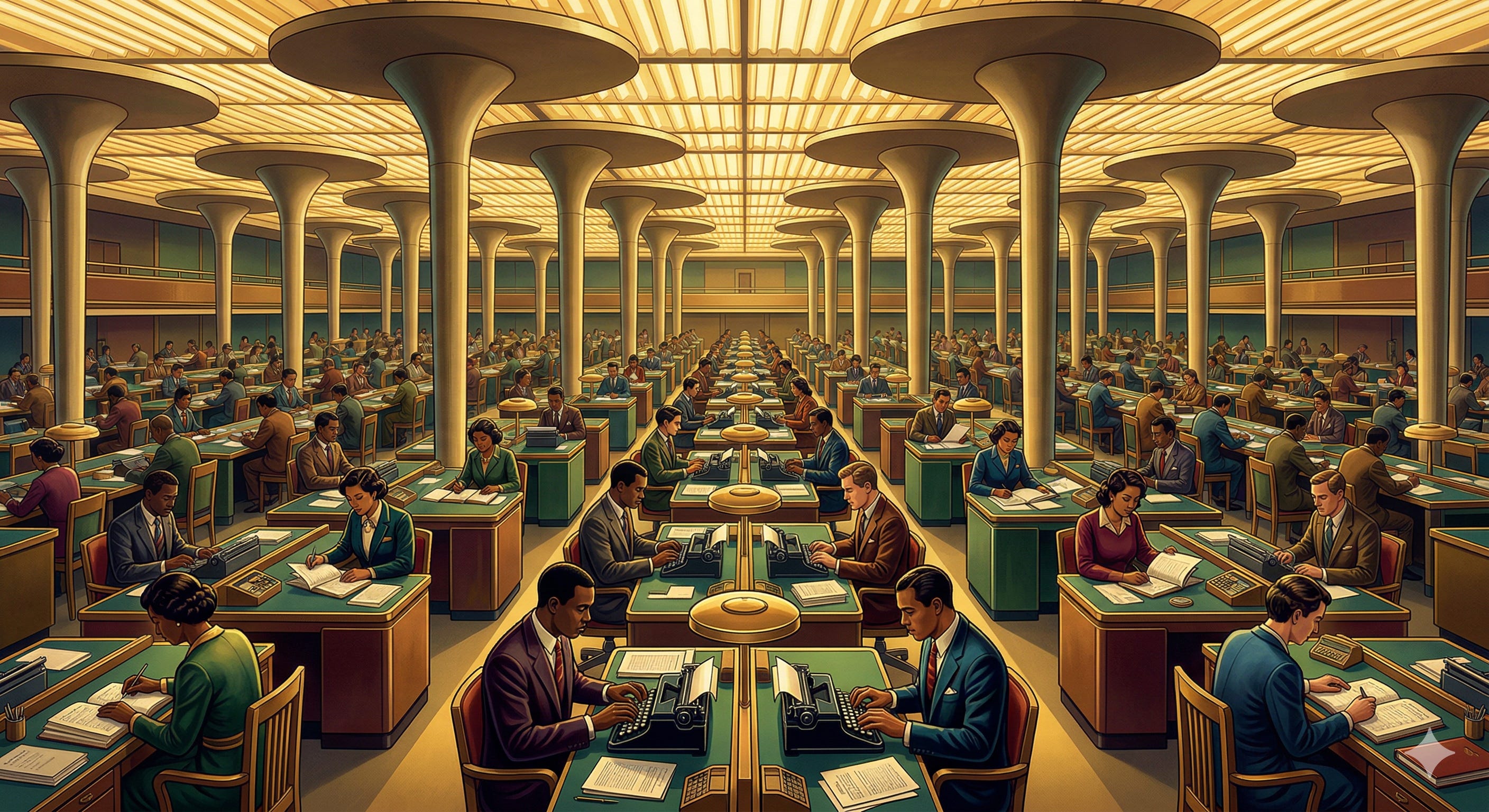
Why are our offices so much more chaotic than our factories? [1]
AI might only make this worse, as office workers use large language models to create inefficiency more efficiently -- the Jevons Paradox applies to busy work too!
Sally will use AI to create a 300-page manual on policies for policy compliance.
Himanshu will use AI to summarize Sally’s manual into a set of action items.
Bill will use AI to schedule a meeting to review the action items that Himanshu suggested.
After the meeting, Igor will try to convince Himanshu, across a 50-message email thread, that Sally’s policy manual doesn’t really require action item 4.
Igor meets with Sally every week to review the compliance-tracking spreadsheet he used AI to create.
The gang produces nothing but compliance.
Where does this take us? Where will growth and innovation come from as a monotonically increasing fraction of humanity devotes its days to writing, analyzing, and complying with policy manuals? Also, does anybody enjoy this, except Sally?
So what do we do about this? As technologists we promised that we could improve office productivity. When I listened to Joe Jackson’s song Tomorrow’s World in college, I didn’t hear anything about creating inefficiency more efficiently.
Some of this is cultural, and hard for us to address. We live in a more bureaucratic and risk-averse age. Some of this is good -- no you shouldn’t put sensitive information on an unencrypted thumb drive. But, in aggregate, what was a Tuesday afternoon in 1999 is a firing offense today. For decades social thinkers have sought to replace Napoleonic leadership with consensus management. Yes, management by diktat is bad, but so is a world where everybody can say no, and nobody can say yes. [1]
What does a CIO or CTO do about this? You aren’t going to unwind a connection between societal wealth and risk aversion with your project portfolio. But there may be a few actions you can take to reduce the chaos.
1. Champion data modeling as a skill set, even outside of the technology organization
When still an academic, Robert Reich wrote an interesting book called The Work of Nations, which divided jobs into three categories: routine production (working on a manufacturing line), in-person services (being a nanny), and symbolic-analytic work (largely white-collar office work).
Reich posited that symbolic analysts identify and solve problems by working with ideas, data, and abstractions. They collect data and use that to build models representing bits of the world -- financial models of entire companies, process models of business domains.
So we have millions of people dressed in business casual paid a lot of money to build representations of the world -- and only the tiniest fraction of them grasp even the basic principles of data modeling.
Imagine if the people structuring business cases, financial models, business strategies and operational reports understood the difference between 1:1, 1:many, and many:many relationships.
This problem will only get worse. GenAI will vastly expand the data we can analyze by converting unstructured text to structured data. The machines won’t magically create ontologies for us. I spent last week tuning the data model for ProsaicGraff, for example combining multiple entity classes to support easier decomposition -- deciding to do this required judgment about the business problems I need to solve. At the same time, universities may not be teaching the basics here. I spoke to several students taking classes in data science who looked at me blankly when I asked them about Codd Normal Form.
Imagine if CIOs, CTOs (and CDOs!) could ensure that everyone in the enterprise technology organization knew how to model data. Imagine they could help knowledge workers in marketing, strategy, finance and operations understand at least the basic principles of data models. Would that reduce some of the chaos as office workers seek to understand the company around them?
2. Deconstruct the office suite
Unix is awesome, in part, because it is composable. You can build complex behavior by chaining together small, simple programs that read text via stdin and write text via stdout.
When a programmer types the following line into the terminal
cat access.log | grep “ERROR” | sort | uniq -c | sort -nr | head
she tells the OS to read a file, search for a string, sort the results, count the results, sort them, and show the first ten items in the ranking. Wow -- imagine if office workers had that type of power in making their sales or marketing plans! But the modern office suite is the opposite of Unix -- it prevents composition by collapsing data, logic, and presentation into monolithic files.
Do you remember MSFT’s Project Longhorn? Its WinFS stream would have created a relational/semantic layer over the file system. Files would be typed objects, supporting rich relationships and SQL-like queries. It would have been a knowledge graph for the desktop before knowledge graphs were cool. Sadly, the early 2000s technology may not have supported the vision, so MSFT reset Longhorn and shipped it as Vista without the file system innovations.
Maybe WinFS would have given office users some of the power in working with documents that programmers have when they manipulate text in Unix. More importantly, we should remember that the current mode of copying and pasting data between email clients, word processors, spreadsheets, and presentation software is not eternal. It started back in the 1990s, and maybe it could end. Given the chaos that rules most office workers’ professional lives, maybe CIOs and CTOs should end it.
That could mean replacing traditional word processing software with DocOps pipelines that produce documents-as-code. Or it could mean blowing up the traditional spreadsheet.
I don’t want an LLM to help me structure a better spreadsheet. I want never to create another spreadsheet again for the rest of my career. I don’t want to scroll through endless rows and columns. I don’t want to try to compress n-dimensional data into a 2.5 dimensional construct. [3] I don’t want to munge the data, logic, and presentation layers into one file.
I want to store complex data in a JSON database. I want to use an LLM to generate robust queries against it. I want to create business logic separate from the data. And I want options for piping the results into different visualization mechanisms.
Will that require behavior change? Yes -- a very small quantum of change compared to the advent of spreadsheet and word processing software. Before the advent of VisiCalc and Lotus 1-2-3, clerks entered data, not managers and executives. Executives couldn’t even use a keyboard -- they wrote memos by dictating them to their assistants. Compared to the behavioral change required between the late 1970s and the early 1990s, giving up your traditional word-processing package for a DocOps pipeline is small beer.
CIOs and CTOs have a critical role to play here in shaping a less chaotic future. What should a DocOps pipeline look like? Will it use XML, Markdown, or a proprietary document format? If we blow up the spreadsheet, can we interconnect data stores, so we don’t replace fragmented, atomistic spreadsheet files with fragmented, atomistic JSON stores? If we represent financial models as a series of equations, where do we store the equations, and should we subject them to change control?
I hypothesize that managing relationships as first-class elements of your data model will be essential. But that is just a hypothesis -- we have many innings of baseball left to play here.
3. Build MIS that supports a systems-thinking view of the business
We’ve all read about the rogue AI that destroys humanity because it wants to use all the matter in the solar system to fulfill its objective of maximizing paperclip production.
I’m not worried about AI fixated on paper clip production [4] -- I worry about Sally, who will demand compliance with her policies on policy compliance. And about the VP of sales who will push for every last deal, pumping up growth with unprofitable revenues. About the procurement manager focused on unit cost over quality. The HR director pushing for a location mix or a pyramid structure that prevents line managers from attracting talent. Even the CISO who cares not for speed or innovation in setting control objectives and performing risk assessments.
Sometimes the modern corporation feels like a series of tribes, each with its own imperative, all working at cross-purposes to one another. This makes life awfully tough for senior executives as the Street will start with questions about profitability and economic value. The imperatives of each individual unit? Less important to shareholders.
Business strategy requires systems thinking, and better systems thinking leads to better business performance. You have to look at all the component parts and all the constraints in order to move from managing individual silos to managing the business as a whole. Anthropic seems to acknowledge this -- but building systems thinking into the way you manage the business requires more than a prompt.
It requires, to use an old-fashioned term, MIS built on systems-thinking logic that surfaces and quantifies the implications that decisions made in one area will have on all the other areas. Most companies suffer from MIS that does the opposite of this -- that provides information on purchased-goods costs to procurement managers, pipeline information to sales managers, and compliance information to compliance managers. Current MIS (whether called business intelligence, data warehousing or decision support) doesn’t integrate across organizational silos, and provides precious little support for what-if analysis, so it helps most with narrow, execution tasks.
CIOs and CTOs have a unique role in the modern corporation. Other than the CEO (and maybe the COO and CFO), only they see all the moving parts in the machine -- because they support all of them. They see the entire graph. How can CIOs and CTOs advocate for the MIS that helps the organization manage the business as a system?
Traditionally, CIOs have said solving problems like this required multi-year, multi-hundred-million-dollar ERP implementations. ERP is still important -- transaction integrity will always matter.
But there may be an opportunity now to decouple business insight from heavyweight ERP programs. GenAI is bad at many things (like writing!) but it’s really good at validating and integrating data. CIOs and CTOs can now build platforms that illuminate how the thorny tradeoffs senior executives face will shape financial performance across the entire business -- without modernizing all the underlying systems. That is an interesting role for CIOs and CTOs to play.
Every technologist my age (i.e., old enough to remember mixtapes) that I know says the same thing. It feels like the 1980s. By that, I think we mean everything is up in the air, and we can use technology in new ways we hadn’t thought of before.
CIOs and CTOs can take advantage of this moment of uncertainty to help reshape the way knowledge workers use technology to reduce the chaos and bring more of the productivity gains the world has achieved on the factory floor to the office.
Footnotes
[1] The footnote here could be: “Have you ever been to an office? Have you ever sat in a meeting?” But:
More than twenty years ago the OECD noted faster productivity growth in the factory-intensive manufacturing sector than in the office-intensive service sector.
Perhaps contradicting my hypothesis, the OECD also reports better productivity growth in knowledge-intensive service industries than in other ones.
Yes, always take vendor-supported research with a grain of salt -- but this Asana study on work about work is interesting
For all these reasons, I like to say: “You think the guy behind the guy behind the guy is Sam the Eagle? No, it’s Gonzo. Fozzie helps.”
[2] Society must ask: how do we get the brilliance of Austerlitz and Jena, without an inclination to seize Moscow?
[3] X = columns; Y = rows; Z = sheets
[4] We can fix that with one line in the prompt, even if we can’t crib the language from Isaac Asimov.