

What does a late 1940s speech by a British writer of detective novels have to do with building support across the executive team for your next business case? A few weeks ago I wrote about how CIOs and CTOs can use game theory to influence the organization in order to secure the resources and support required to maximize EBITDA lift from enterprise technology. AI provides another lever.
The classical skills of grammar, logic and rhetoric are essential to advocating for good business decisions in complex organizations.
Making shoddy arguments is easy in the face of time pressure and incomplete information.
Using AI to evaluate my own writing demonstrates how it can identify vulnerabilities in an argument.
A simple prompt enables you to apply this to your own work -- but you should treat the output as a guide, not a mandate.
1. Reviving the Trivium
In 1947, British writer Dorothy Sayers urged educators to embrace the principles of classical education, in the face of a culture of specialization.
Sayers worried that educators had failed to teach students how to learn, think and communicate. She wrote:
Is it not the great defect of our education to-day (—a defect traceable through all the disquieting symptoms of trouble that I have mentioned—) that although we often succeed in teaching our pupils “subjects,” we fail lamentably on the whole in teaching them how to think? They learn everything, except the art of learning.
Sayers offered the trivium as a solution. Roman thinker Martianus Capella divided the liberal arts into the Trivium (grammar, logic and rhetoric) and Quadrivium (arithmetic, geometry, astronomy and music).
The whole of the Trivium was in fact intended to teach the pupil the proper use of the tools of learning, before he began to apply them to “subjects” at all.
The Trivium applies in a special way to enterprise technologists. Engineers have always needed to make thorny design decisions and write technical specifications. The advent of spec-driven development will only make the Trivium more important to them. As Steve Jobs said, “It’s in Apple’s DNA that technology alone is not enough—it’s technology married with liberal arts, married with the humanities, that yields the results that make our hearts sing.”
Especially today -- no less than the students Sayers worried about -- enterprise technologists must be learners given the pace of change they face. The Trivium allows them to assimilate and evaluate new ideas more quickly.
Technologists must make -- in the face of incomplete information and massive ambiguity -- decisions they will have to live with for years. As my old professor Martha Nussbaum pointed out, critical thinking, argumentation, and narrative imagination are essential for making decisions in complex systems. [1]
No CIO or CTO is a sovereign. They need support and engagement from the rest of the management team to create a portfolio, define requirements, fund platforms and get value from systems investments. So they must make arguments. How many meetings have blown up because nobody asked, “What would the counter-argument be? Why would the client disagree?” How many initiatives have progressed because the business case anticipated the rebuttal the CFO might offer?
2. How robust is our thinking?
Can CIOs and CTOs make better arguments? In How AI Critiques an Argument, Steven Mintz [2] of the University of Texas, Austin suggests even trained professionals make shoddy arguments:
Honest argument requires specifying not just the claim and evidence but the warrants, qualifications, and rebuttals — the conditions under which the claim would not hold
Social incentives and norms (in education, in media) encourage speed, certainty, and strong positions over nuance and qualification -- we learn to overclaim, reducing causation to a single cause and crowding out alternatives with false dilemmas
When challenged we learn to evade — changing the subject, moving the goalposts, retreating to vagueness.
Do the failure modes resonate here? Sometimes they do. Sometimes the imperative of just getting through the week or getting the document done leads to motivated reasoning, vagueness and over-simplification. [3]
One of my mentors used to counsel me “The direction of the hypothesis doesn’t matter here -- we’ll either prove or disprove it.” But how often does “Bottom Line Up Front” mean “start with the answer” rather than “start with a falsifiable proposition to validate or invalidate with facts.” All the time I see people locked into a position they don’t want to re-evaluate.
Mintz points out “And when challenged, arguers evade — changing the subject, moving the goalposts, retreating to vagueness.” How many of us have the fortitude to meet an objection head on? Or do we respond to clarifying questions with defensiveness and more vagueness?
I heard more than one CEO ask of the CIO “why does this have to be so complicated?” But you must use clear structure and clear writing to communicate nuance honestly. And not confuse the sometimes brutal reductionism required in decision making (i.e. go left or go right; launch the project or don’t) with all the nuance that goes into making that decision.
But Mintz also offers hope, in that AI can help us make better arguments -- as a complement to, not a replacement for, management judgment. We are all often time-constrained, stressed, distracted or exhausted -- AI is not any of those things.
AI models the structural habits of careful argument more consistently than most humans educated to develop them: well-functioning AI follows a deliberative sequence before rendering judgment: reconstruct, calibrate, consider alternatives, steelman, treat the first response as provisional
AI can provide immediate and specific correction of argumentative failures — showing exactly what a fair restatement looks like, where a causal claim outruns the evidence, which alternatives a false dilemma has collapsed
3. Applying Mintz’s advice to my writing
Mintz recommended three frameworks in his piece.
Toulmin evaluates the structural anatomy of an argument — claim, evidence, warrant, backing, qualifier, and rebuttal
Paul-Elder evaluates the intellectual quality of the thinking behind the argument — clarity, accuracy, precision, relevance, depth, breadth, logic, and fairness
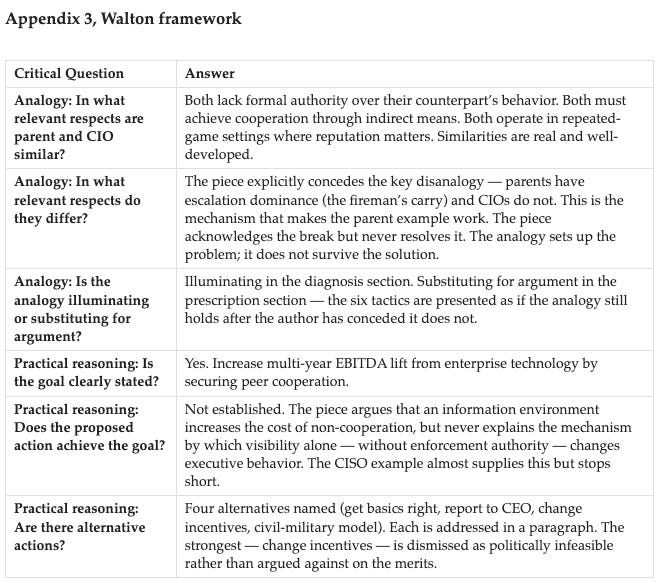
Walton identifies what type of argument is being made — analogy, causal, from authority, practical reasoning, from example — and then applies the critical questions specific to that type
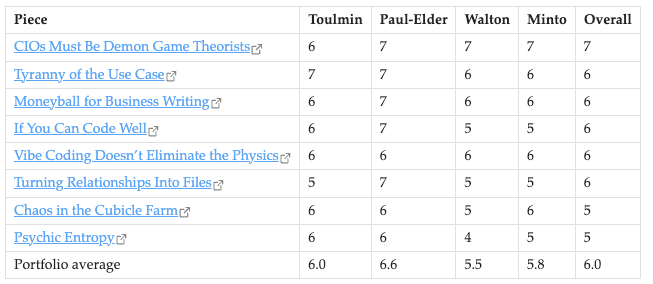
I used an agent to evaluate Just like parents CIOs must be demon game theorists to elicit cooperation in terms of each framework plus Minto’s pyramid principle. Clearly I have work to do. None of the articles received more than seven points out of ten!
What do I need to do differently?
Be explicit in naming the warrant that connects my evidence to my conclusion
Engage directly with the strongest possible objections to my arguments, especially when using analogies
Map prescriptions to diagnoses
Explain why personal experiences are generally applicable
4. A prompt you can use
My writing has gotten better because I revise and revise based on feedback from agents and prompts. The prompt I used above even made this article better. As I used the prompt through about 10 iterations of the article my score improved from the mid-5s to 8.5. Here are some of the tweaks.
I originally just asserted that better arguments win; with some encouragement from the prompt, I provided a few illustrations of how incomplete arguments can sabotage a meeting -- and rigorous ones can win the room. (Yes, I would have liked to be more specific -- but in some cases I must be discrete.)
I also didn’t address an important potential objection to one of my key points. Some people believe CIOs win with good relationships rather than good arguments. I added a footnote explaining you need good relationships and good arguments (and the two reinforce each other).
Sometimes I addressed these issues in footnotes, in order to preserve narrative flow. If the CFO asks a killer question and you say, in response, let’s turn to page 25 in the appendix where we address that issue, that works great.
Try it on your next initiative request with this prompt.
But treat it as a guide, not a mandate. No prompt will capture all the context you have -- so sometimes the model will recommend justifying a proposition your audience will stipulate. Models can also be literal. Sometimes I should spell out my warrants, but sometimes letting the reader do a little work in connecting the dots creates investment in argument.
Footnotes
[1] Two notes here:
In the spirit of transparency I took Nussbaum’s class “Philosophy and the Novel” with 200 other students. The lectures were terrific.
Yes, in her book, Nussbaum talks about the humanities in the context of protecting democracy rather than improving corporations, but companies are themselves polities, with bylaws as constitutions and elections for boards of directors.
[2] Mintz is a professor of history at the University of Texas at Austin and a leading commentator on pedagogy and critical thinking. He writes the Higher Ed Gamma column at Inside Higher Ed and received the AAC&U’s President’s Award for Outstanding Contributions to Liberal Education in 2025.
[3] I know some have argued that relationships, not great problem solving and great arguments, win the day. Here’s why that doesn’t resonate for me.
Great CIOs depend on great business relationships and great arguments -- and great arguments make for better business relationships.
In a world where you’ll live with the impacts of today’s decisions for years, you want only the best arguments in the boardroom.
Executive teams change. The business partner who doesn’t challenge you may take another job. His or her replacement might look at a business case and ask “What the bloody hell is this?”
Appendices
As noted above, I used AI to apply 4 argument frameworks to Just like parents CIOs must be demon game theorists to elicit cooperation. Here’s what it said:
Thesis: CIOs/CTOs need cross–executive-suite cooperation to maximize multi-year EBITDA lift from enterprise technology, but coordination costs (information asymmetry, misaligned incentives, collective-action problems, weak “enforcement” inside the firm) make that cooperation scarce—so they have to think like game theorists, not optimists or petitioners.
Analogy: Parents can sometimes establish escalation dominance (the piece’s restaurant / fireman’s-carry example); technology leaders usually cannot, so the workable substitute is to shape an information environment that raises the cost of non-cooperation rather than pretending good intent or a CEO edict will fix incentives.
Mechanism: An EBITDA-lift model (value leakage, adoption loss, deadweight loss, run cost / T4T) to show where cooperation matters, despite symmetric frustrations between technology leaders and their peers. Only ~13% of senior technology executives report consistently getting the support and engagement needed to capture value—so the bottleneck is governance and politics.
Prescription: Six tactics—develop a granular view of where cooperation drives lift; map political constraints coolly; force decisions with options and implications; make cooperation visible (including board-level transparency where appropriate); adopt “not my fault, but my problem”; and signal credibility (e.g., eating your own cooking on new ways of working)—as the practical translation of “demon game theorist,” not as a mandate to strong-arm peers.
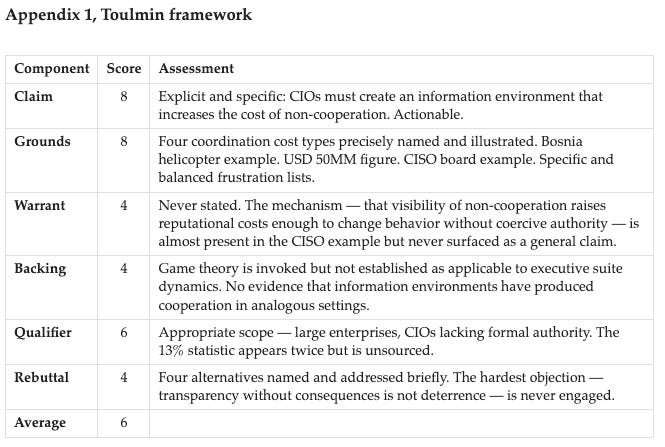
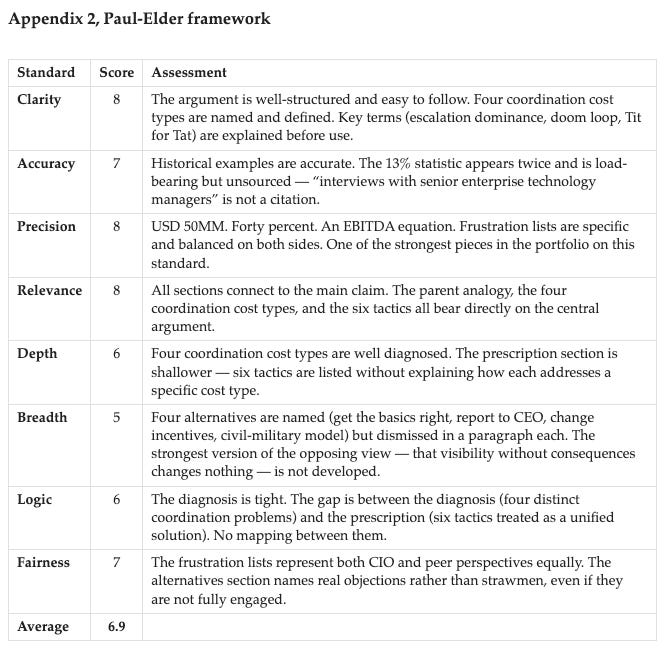
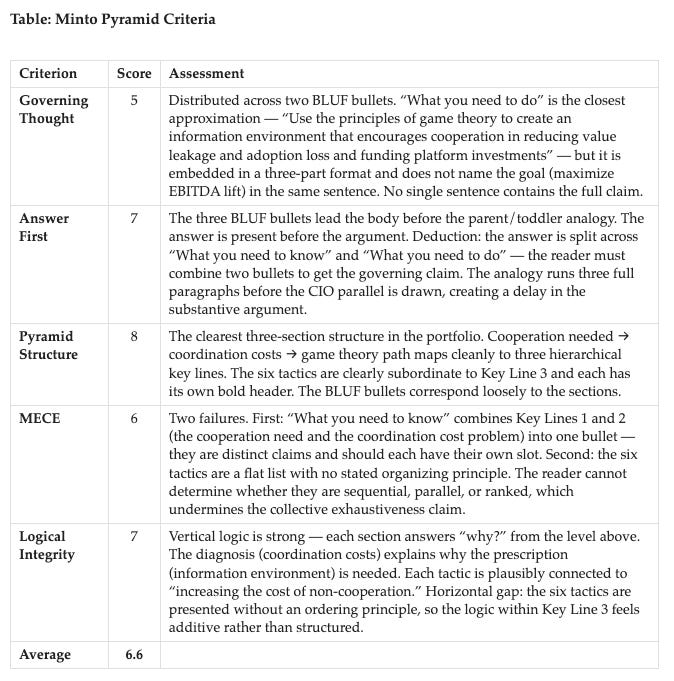
Minto summary: The piece’s most important structural failure is at the BLUF level: “What you need to know” bundles two distinct key lines — the EBITDA cooperation need and the coordination cost diagnosis — into a single bullet, when they each deserve their own slot. A truly MECE BLUF would have three bullets: (1) CIOs need cross-executive cooperation to maximize EBITDA lift; (2) coordination costs explain why they rarely get it; (3) game theory provides a path — and the six tactics below show how. The current structure is close but the compression at the BLUF level obscures the argument’s logical spine.