

What you need to know: Agentic automation will reduce friction, but imperfectly and only over years, so white collar work will not disappear anytime soon
What you need to do: Determine where agentic automation will reduce friction and improve decision-making -- and where it will just lead to demand for more analysis
What you need to decide: How to ask the rest of the management team about attacking the organizational behaviors that will reduce the economic value of agentic automation
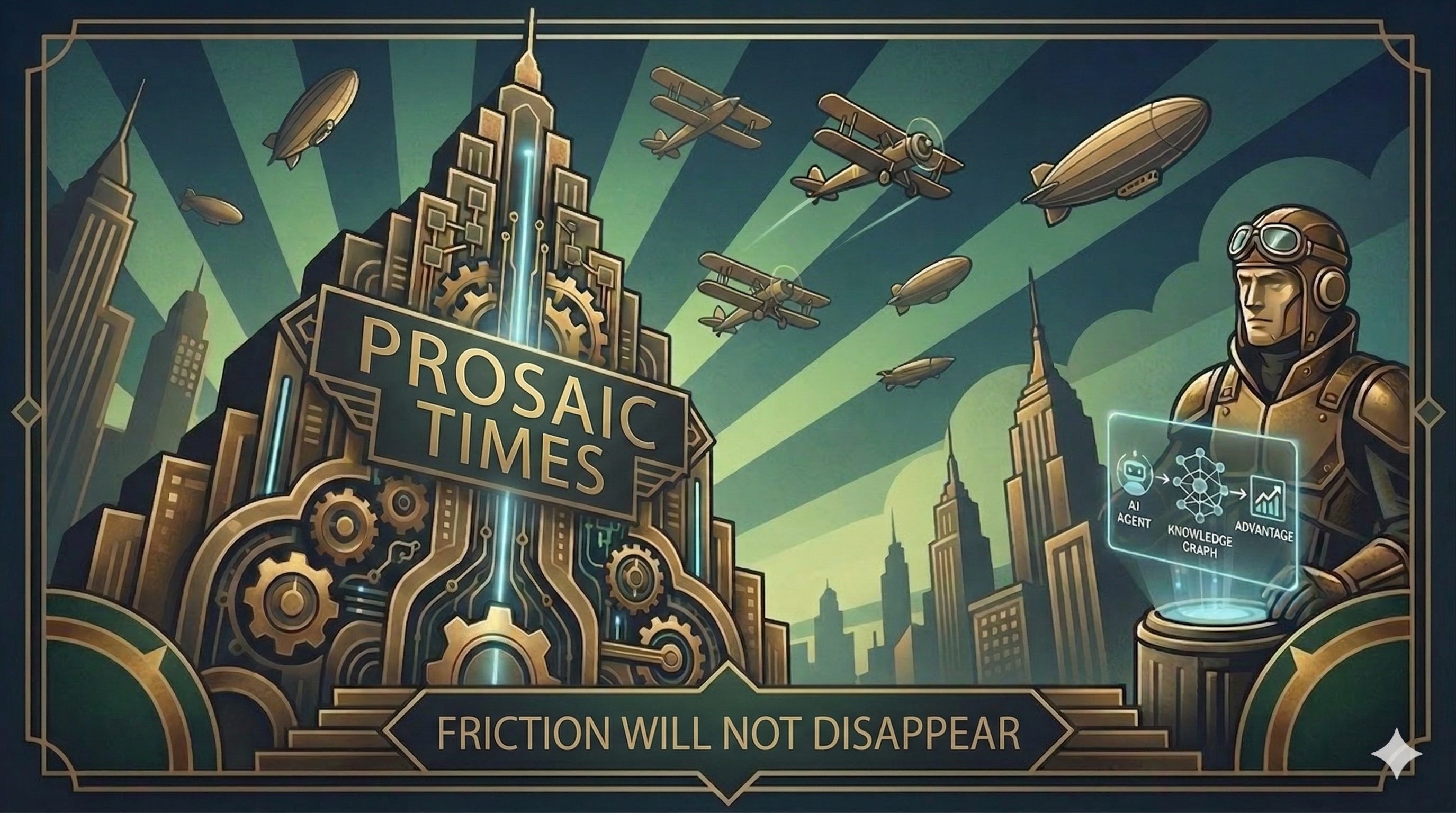
To all those who have not emailed me to ask about the Citrini Research report, The 2028 Global Intelligence Crisis, thank you for your forbearance. To all those who have emailed, texted or Slacked me -- and to whom I have responded “eh, don’t fuss” here’s why: the world economy has plenty of friction; the Jevons Paradox applies to busywork and somebody has to run the dang machines.
The report argues:
Autonomous AI agents will eliminate economic friction monetized by banks, professional services firms, brokers and software providers
This will increase corporate margins, but eviscerate white-collar employment
Which will lead to a deflationary spiral because owners of capital will never consume as much as workers will
Bloody hell, where to start?
We have a long way to go before we see the end of friction in corporate life
I try to avoid ad hominem arguments, but I will employ one here. [1] I expect Alap Shah is a brilliant individual, but he seems to have worked at relatively intimate hedge funds and technology start-ups, with few employees and low coordination costs. Had he ever waded through the data center consolidation program for a very large financial institution [2], he might be less inclined to predict that AI agents will solve friction in advanced economies.
Carl von Clausewitz used the conception of friction to explain why even simple plans go astray -- friction makes “even the simplest thing difficult.” But remember the context: Clausewitz served as Chief of Staff to III Prussian Corps, which had no more than 25,000 men under arms. It operated mostly in the Low Countries. It had infantry, cavalry and artillery -- and obviously no air, armor or other complicated machinery. Perhaps more importantly everyone shared a common understanding of major concepts -- nobody had to ask “well, what do you mean when you say infantry.” Also, the Prussian Army in their era imposed iron discipline on its ranks. Commanders expect to see their orders carried out, with no shirking or creative re-interpretation.
Spending a few days in a large, modern corporation Clausewitz might well disclaim ever having understood friction. He would realize that compared to his tidy Prussian army corps corporate American is a festival of frictions, with endless ontological ambiguities [3], conflicting agendas and divergent processes -- often scattered among hundreds of thousands of employees located in dozens of countries. The Prussian Army created a staff system to provide its commanders with transparency into battlefield situations. Seeing incomplete information almost any corporate executive has to rely on (and therefore the guesswork required for decision-making) any nineteenth century Junker would throw up his hands in despair and retire to his Ostelbein estate.
Will agentic automation reduce friction? I’m betting my career on it. Could it upend the payments ecosystem, but removing the friction from it, as the article suggests? Hell, yes. But payments (especially consumer payments) is one of the lower-friction parts of corporate life. When you remove the friction for customer onboarding in the enterprise sector, come back to me and we’ll talk. Yes, agentic automation puts untold riches on the table, but we have decades of baseball left to play here. Robert Fulton launched the first commercial steamship service in 1807. More than a century later the United Kingdom still received copper shipments from Chile via sailing ship. As Jeffrey Ding reminds in the Technology and Rise of Great Powers, disseminating new technologies takes a lot of effort and long time.
The Jevons Paradox also applies to busywork
In the past I’ve written about how powerfully Jevons paradox applies to knowledge work. Knowledge work allows us to know more about the world, and at least on good days make better decisions. Reducing the unit cost of insight will increase the demand for knowledge work because that, on good days, allows us to make good decisions. For example reducing the unit cost of legal discovery...increases the number of documents discovered.
But does that lead to better outcomes? The relationship between more insight and better decisions is neither obviously nor linear. Culturally, we all read Substack newsletters and wear business casual, but biologically we differ little from our predecessors who lived in caves and tried to chase game over cliffs. We make decisions based on some non-linear interactions between rational calculation of neurobiological imperatives like fear of embarrassment or exclusion. We can measure a few things psychological traits like g and conscientiousness. But anyone who’s had to scrutinize their child’s neuro-psych exam knows that we’re only a couple of steps up from witchcraft understanding how humans process information.
People believe irrational things. There are people with advanced degrees who not only claim to understand Judith Butler’s philosophy but say they agree with it. I’ve seen in meetings where highly compensated people insisted broadband dial-up was a fad or server virtualization would never work. You could give me access to all the GPUs and TPUs in this solar system and the next one, and I’d never answer the question. I’d like to believe that insight triumphs over irrationality and leads to better decisions, but you know I’m often-times wrong on that score. Sometimes more insight (what Clausewitz would have called better staff work) just leads to demand for more analysis, rather than a better decision or any decision at all. Seeing how easy it is to crunch the numbers, a deadlocked executive team calls for yet another turn of the model, rather than confronting the core sources of disagreement.
Sadly, it gets darker than this, knowledge work sometimes becomes a kissing of the ring. Years ago, (back when banks built their own data centers) I helped a giant financial institution develop the business case for its data center modernization program. I was very proud of the work -- we helped them figure out how to get more resiliency for hundreds of millions of dollars less than they originally expected. After we helped the CTO get support from the executive committee, he told us “I’ve got it from here.” His team could develop the hundreds of pages they needed to brief the regulator.
It proved a frustrating interaction. The CTO and his team presented their 100-plus document, with details on demand trends, tiering levels, modularity and hot aisle/cold aisle configuration to the senior regulator. At the end of the presentation, I understand the regulator said “This is great. Could we go back to page three -- I have a question there.” The team frenetically flipped backward on the projector. Page 3 showed the classic demand drivers: OS images, GBps of network bandwidth and petabytes of storage all climbing to the sky. The regulator asked, “What’s a petabyte?”
The CTO grew so angry he had to leave the room. If the regulator didn’t even understand the idea of a petabyte, how could he have learned anything from the presentation? His team spent months just to demonstrate to the regulator that they were willing to spend months on a presentation. Let’s not, of course, think that this only applies to regulatory oversight. How many times have we, in seeking to get approval for a plan, had to deliver a special briefing to the head of Europe, or mid-market channels, or audit or some other constituency? Sometimes these discussions involve real issues -- sometimes they just signaled that you cared enough to develop a 30 page presentation.
If the purpose is signaling, agentic AI risks degrading the currency. If the cost of analysis declines by 90 percent, one stakeholder or another might demand 10x the analysis, just to make sure that you cared.
Somebody has to run the dang machines
You might argue that all my points about friction, irrationality and busy work just strengthen the case for taking the humans out of the system. To an extent, I agree -- using agentic automation to displace irrationality and confusion will generate massive economic value in coming decades.
But we live in a human world. Customers are human. Employees are human. Regulators are human. Even investors are human and subject to the same biases and irrationality described above. And Large Language Models are highly imperfect themselves, in a different way that will not change quickly. Yes compute capacity climbs to the sky (as it has been for decades), but access to memory scales less quickly and remains the bottleneck.
The result? Lossy compression, occasional hallucinations and the imperative to manage context relentlessly. Especially when dealing with ambiguous problems (like ones involving human beings and large organizations), context quality drives decision quality. Maybe we should start using the term “context-collar” work rather than “white-collar” work -- because providing context is interesting, demanding work. We see this from the software engineers who tell us about the cognitive load they face in keeping a dozen software engineering agents on task and on track. Could agents help lighten the load in managing other agents? They already do! But there has to be a human (probably a fair number of humans) at the end of the chain. Machines don’t run themselves.
A gradual transition
Will agentic automation put paid to uncountable hours of low-quality white collar work? Without question? Will companies that pull up their socks and use improved knowledge worker productivity to make better decisions rather than placate internal stakeholders take share from competitors do not? Of course. But in a world with structural barriers like brand equity, regulatory barriers, switching costs that will play out over years if not decades. [4]
Footnotes
[1] Reminder: an ad hominem argument is not a personal attack. Instead it impeaches an argument based on the credibility of the person making it. When a sportscaster who is a retired ballplayer dismisses a point made by a fellow talking head because he never played in the majors, that’s an ad hominem argument.
[2] Well, how did you spend your 30s?
[3] What is a product? What is a customer? What is a service offering? What is a policy? What is a standard? What is an application? What is a program? What is a project?
[4] With a declining number of college graduates further mitigating the impact.
I've been thinking about how you might apply agentic analysis to the software project analysis process we used to run. Your article reminded me of a glib comment made by the then CTO about that way to get an effective investment management process would be to RIF the business middle management ranks by 80%.
"I didn't get a harrumph out of that guy..." https://www.youtube.com/watch?v=uTmfwklFM-M
I specifically appreciated your analysis of game theory as a tool for CIOs to elicit cooperation. From an Economics-Mathematics perspective, your breakdown of the barriers to maximizing EBITDA lift was a fresh take. Often, enterprise tech discourse focuses on the 'vibe' of the code, but ignores the deadweight loss and value leakage that occur during adoption. Framing IT hurdles as game-theoretic problems makes the solution feel much more engineering-led rather than just cultural.
If you’re looking for feedback on the 'product': I think a brief 'Bottom Line Up Front' (BLUF) section at the start of the longer deep dives—like the one with Philip Rathle—would be helpful for the LinkedIn version. It mirrors that high-impact McKinsey style and helps 'busy' readers anchor the technical insights to a strategic takeaway immediately.