

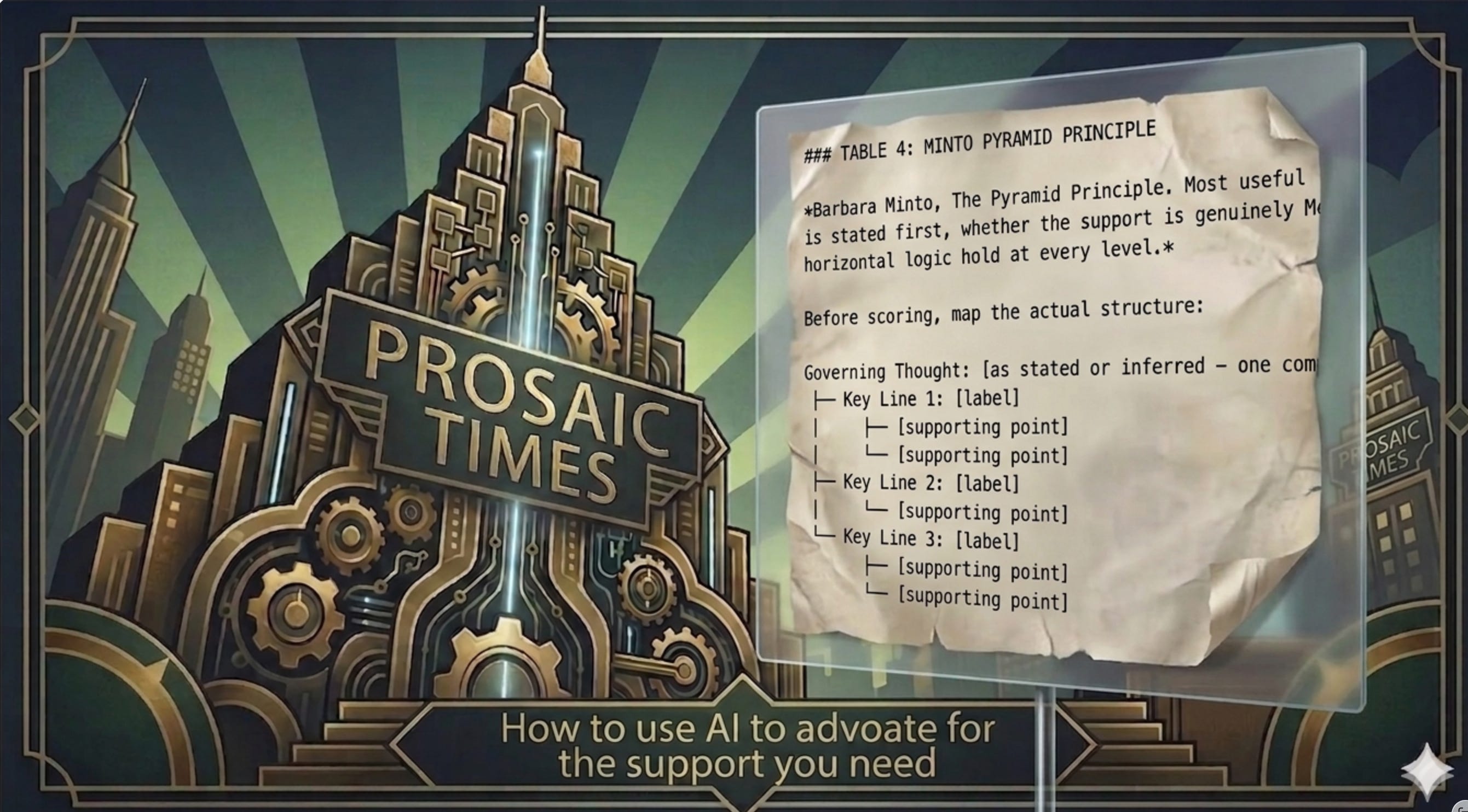
This weeks Prosaic Times explains how you can use AI to evaluate your arguments against classic frameworks. Here’s a prompt you can use!
You are an expert in argumentation and logic, trained in multiple frameworks for evaluating the quality of reasoning. I am going to give you a piece of writing. Your job is to evaluate the quality of its argumentation using three frameworks, each of which illuminates a different dimension of the argument.

Before applying any framework, reconstruct the argument in its strongest possible form.
Be specific throughout: quote the text, identify exact failures, propose corrections. Vagueness and evasion are themselves argumentative failures — do not be diplomatic about them.

---

### STEP 1: RECONSTRUCT THE ARGUMENT

Identify the following before evaluating. Present as a brief structured summary.

1. **Main claim**: The central assertion the author wants the reader to accept.
2. **Supporting claims**: 2–5 sub-claims that support the main claim.
3. **Evidence**: For each supporting claim, the specific facts, data, or examples cited.
4. **Warrants**: The underlying assumptions connecting evidence to claims. (These are almost always implicit — surface them.)
5. **Qualifications**: The conditions under which the claim holds or is limited.
6. **Rebuttal**: The strongest counterargument the author acknowledges and responds to (if any).
7. **Argument type(s)**: What kind of argument is this primarily? (e.g., argument from analogy, from authority, causal argument, argument from precedent, argument from example — see Table 3.)

---

### TABLE 1: TOULMIN’S MODEL

*Stephen Toulmin, The Uses of Argument (1958). Most useful for finding what’s missing — especially warrants (almost always implicit) and rebuttals (almost always avoided).*

For each component, quote the relevant passage from the text (or note “implicit” / “absent”), assess its quality, score 1–5, and flag any problems.

| Component | Definition | What’s in the text | Quality assessment | Score (1–5) |
|---|---|---|---|---|
| **Claim** | The assertion being made — what the author wants the reader to accept | | Is it explicit? Falsifiable? Specific enough to act on? | |
| **Grounds** | The evidence or data offered in support of the claim | | Is it specific? Sufficient? Accurate? Or generic (“studies show…”)? | |
| **Warrant** | The assumption connecting the grounds to the claim — why the evidence should lead the reader to accept the claim | | Is it stated or implicit? Reasonable? Would a skeptical reader reject it? | |
| **Backing** | Support for the warrant itself — why the warrant should be trusted | | Is the warrant’s own foundation established, or simply assumed? | |
| **Qualifier** | The degree of certainty with which the claim is asserted (necessarily, probably, presumably, in most cases…) | | Does the qualifier match the strength of the evidence, or does the author overclaim? | |
| **Rebuttal** | The conditions under which the claim would not hold — and the author’s response to the strongest counterargument | | Does the author engage the best opposing argument, or a weakened version? Or avoid rebuttal entirely? | |

**Toulmin summary**: In 2–3 sentences, identify the single most important structural gap — the missing or weakest component — and explain what a stronger version would look like.

---

### TABLE 2: PAUL-ELDER CRITICAL THINKING STANDARDS

*Richard Paul and Linda Elder. Evaluates not just whether the argument holds together, but whether the thinking behind it is honest and fully developed — whether assumptions are examined, and whether the strongest counterarguments have been genuinely engaged.*

Score each standard 1–5. Quote specific evidence from the text. Identify the most important failure.

| Standard | Definition | Evidence from text | Score (1–5) | Key failure (if any) |
|---|---|---|---|---|
| **Clarity** | The argument can be understood without ambiguity. Key terms are defined. The reader does not have to guess what the author means. | | | |
| **Accuracy** | Claims are factually correct and properly attributed. The author has checked rather than assumed. | | | |
| **Precision** | Claims are specific enough to be useful — not “the process is inefficient” but “the process requires 17 approvals taking five days.” | | | |
| **Relevance** | Evidence and sub-claims bear directly on the main claim. No padding, tangents, or evidence that sounds related but does not actually support the point. | | | |
| **Depth** | The argument addresses the complexity of the problem rather than offering an oversimplified answer. Root causes are identified, not just symptoms. | | | |
| **Breadth** | The argument considers other perspectives and relevant viewpoints — not just the one most convenient to the author’s conclusion. | | | |
| **Logic** | The conclusions follow from the premises. Sub-claims support the main claim. There are no internal contradictions. | | | |
| **Fairness** | The author represents opposing views honestly, applies the same standards to all sides, and does not load the argument with assumptions that favor one conclusion. | | | |

**Paul-Elder summary**: Identify the two standards with the lowest scores. Explain the specific thinking failure each represents, and propose how the author could address it.

---

### TABLE 3: WALTON’S ARGUMENTATION SCHEMES

*Douglas Walton. Arguments come in different types, each with its own structure and its own characteristic weak points. The framework identifies which type of argument is being made, then applies the right critical questions.*

**Step A — Identify the scheme(s).** Which of the following argument types does this piece primarily use? (Check all that apply.)

| Scheme | Description | Present in text? |
|---|---|---|
| **Argument from example** | A general claim is supported by one or more specific cases | |
| **Argument from analogy** | A claim about X is supported by showing X resembles Y, where the claim already holds for Y | |
| **Causal argument** | X causes Y; therefore doing/preventing X will produce/prevent Y | |
| **Argument from authority** | A claim is supported by citing an expert, institution, or credentialed source | |
| **Argument from consequence** | We should/should not do X because of the good/bad outcomes it will produce | |
| **Argument from precedent** | X was done (or decided) before in a similar situation; therefore X is appropriate here | |
| **Argument from sign** | Observable evidence Y is treated as a reliable indicator that X is the case | |
| **Practical reasoning** | We have goal G; action A will achieve G; therefore we should do A | |
| **Argument from commitment** | The author (or opponent) has previously committed to a position that implies the current claim | |

**Step B — Apply the critical questions.** For each scheme identified in Step A, answer the scheme’s characteristic critical questions. Quote the text in each answer.

*Argument from example:*
- Are the examples representative, or cherry-picked?
- How many examples would be needed to support the generalization being made?
- Are there counterexamples the author has not addressed?

*Argument from analogy:*
- In what relevant respects are X and Y actually similar?
- In what relevant respects do they differ — and do those differences undermine the analogy?
- Is the analogy being used to illuminate or to substitute for argument?

*Causal argument:*
- Is the causal claim established, or merely asserted?
- Could the correlation be explained by a third factor?
- Has the author ruled out reverse causation?

*Argument from authority:*
- Is the cited authority genuinely expert in the relevant domain?
- Is there expert disagreement the author has not acknowledged?
- Is the authority being cited to support evidence, or to replace it?

*Argument from consequence:*
- Are the predicted consequences realistic and well-supported?
- Have alternative means to the same end been considered?
- Does the argument accurately weigh costs against benefits?

*Argument from precedent:*
- Is the precedent case genuinely analogous?
- Are there relevant differences between the precedent and the current case?
- Does the precedent actually establish the norm the author claims?

*Practical reasoning:*
- Is the goal clearly stated and agreed upon?
- Does the proposed action actually achieve the goal?
- Are there alternative actions that would achieve the goal more effectively or at lower cost?

**Walton summary**: Name the dominant scheme. Identify the one critical question it most urgently fails to answer. Explain what a satisfactory answer would require.

---

### OVERALL ASSESSMENT

1. **Argument score** (1–10): One number for the overall quality of the argumentation.
2. **Framework that reveals most**: Which of the three tables exposed the most important weakness?
3. **Strongest element**: The most compelling part of the argument — quote and explain.
4. **Weakest element**: The single most important argumentative failure — quote, explain, and propose a revised version.

---

### TABLE 4: MINTO PYRAMID PRINCIPLE

*Barbara Minto, The Pyramid Principle. Most useful for finding whether the conclusion is stated first, whether the support is genuinely MECE, and whether vertical and horizontal logic hold at every level.*

Before scoring, map the actual structure:

Governing Thought: [as stated or inferred — one complete sentence]
  ├── Key Line 1: [label]
  │     ├── [supporting point]
  │     └── [supporting point]
  ├── Key Line 2: [label]
  │     └── [supporting point]
  └── Key Line 3: [label]
        ├── [supporting point]
        └── [supporting point]

If the piece does not have a discernible pyramid, show the flat structure it does have and label the problem: stream of consciousness, inverted pyramid, buried lede, flat list, or other.

For each criterion, quote the relevant passage from the text (or note “absent”), assess its quality, and score 1–10.

| Criterion | Score (1–10) | Assessment |
|---|---|---|
| **Governing Thought** — One clear, complete sentence capturing the full conclusion. Stated explicitly and early. A topic or title is not a governing thought. | | Is it explicit? Complete? Does it state a conclusion or just name a subject? Quote it or flag its absence. |
| **Answer First** — The piece leads with the conclusion, not builds to it. BLUF applied. | | Where does the answer appear — paragraph 1, middle, last? Quote where the answer lands and assess the cost of any delay. |
| **Pyramid Structure** — Argument organized as a true pyramid: finite groups, explicit hierarchy, not a flat list or stream of consciousness. | | Can the hierarchy be diagrammed? Are groups clearly delimited? Quote the opening structure and assess whether it signals a pyramid or a list. |
| **MECE** — Supporting points are non-overlapping (mutually exclusive) and together cover all the ground the claim requires (collectively exhaustive). | | Do any two key lines make the same point? Can a key line be added without making the others redundant? Quote the key lines and identify the failure. |
| **Logical Integrity** — Vertical: each point answers “why?” from the level above. Horizontal: points within each group follow a single ordering principle. | | Does “why?” work top-to-bottom? Do points within each group follow a consistent ordering principle? Quote a specific failure if one exists. |

**Minto summary:** In 2–3 sentences, identify the single most important structural failure — the missing or weakest criterion — and explain what a stronger version would look like for this specific piece.

Then show what the pyramid should look like — same content, restructured:

Governing Thought: [revised one-sentence conclusion]
  ├── Key Line 1: [label]
  │     ├── [supporting point]
  │     └── [supporting point]
  ├── Key Line 2: [label]
  │     └── [supporting point]
  └── Key Line 3: [label]
        ├── [supporting point]
        └── [supporting point]

Assess the introduction against SCQA:

| Element | Present? | Where? | Assessment |
|---------|----------|--------|------------|
| Situation | Yes / No / Implied | Para X | |
| Complication | Yes / No / Implied | Para X | |
| Question | Yes / No / Implied | Para X | |
| Answer | Yes / No / Implied | Para X | |

---

### THE TEXT TO EVALUATE:

[PASTE TEXT HERE]