

What you need to know: Maximizing multi-year EBITDA lift requires cooperation from across the executive suite, but coordination costs get in the way
What you need to do: Use the principles of game theory to create an information environment that encourages cooperation in reducing value leakage and adoption loss and funding platform investments
What you need to decide: The specific tactics you should adopt based on economic and organization realities.
Nobody should attempt parenthood without taking a graduate-level class in game theory. You would like to think that your interests and those of your children align perfectly, in the need for you to help your children grow into responsible and honorable adults. Sadly, your children don’t always see it that way, at least in the short term.
You take your toddler to dinner in a restaurant. He thinks: “I want to create as much of a ruckus as I can — that will make me happy. But the ruckus embarrasses dad, and at some point will take me home. I don’t want to go home because I want to create a ruckus here at the restaurant. My dad wants to finish his dinner and continue his conversation with Mommy rather than take me home. So I have to think through: what is the maximum amount of ruckus I can create that falls short of the point where dad’s embarrassment doesn’t exceed his desire to finish dinner?”
I found a solution by establishing what game theorists call escalation dominance. When the kids reached my ruckus threshold, I didn’t just walk them out of the restaurant — I put them over my shoulder in a fireman’s carry. I was very gentle but the kids found this very embarrassing. I had escalated my response from one they didn’t like a little bit, to one they didn’t like a lot, establishing deterrence. Children are demon game theorists; parents must be better ones.
So too for CIOs and CTOs in dealing with their peers on the management team. They need cooperation from their peers in maximizing the multi-year lift in EBITDA from enterprise technology, and they too rarely get it.
You would like to believe in unity of effort across the executive suite in pursuit of shareholder returns, but coordination costs interfere, especially in governing enterprise technology. Executives will have incomplete information and different views on how to improve performance. Different executives may have perverse incentives, different time horizons or varying personal risk appetites. Especially for a function that touches many pieces of the business (as enterprise technology does), collective action problems abound.
So CIOs and CTOs must also be demon game theorists. That doesn’t mean slinging recalcitrant business partners into a fireman’s carry (although many CIOs might like to). Given that CIOs cannot mandate different incentives or structures (they lack escalation dominance!), it means creating an information environment that increases the cost of non-cooperation:
Developing a granular view on where you need cooperation to increase EBITDA lift over time
Coolly assessing the political dynamics across the management team
Presenting options with implications to force decisions
Creating transparency into root causes
Maintaining a clear distinction between fault and responsibility
Engaging in signaling to build credibility
CIOs need cooperation across the executive team to maximize EBITDA lift
Enterprise Technology has two mandates: keep the business running and enable improved business performance in the form of EBITDA lift. [1] Enterprise technology executives have a lot of control (but not complete control) of what they need to keep the business running — but they need more cooperation to maximize EBITDA lift.
Drivers for EBITDA lift
As demonstrated in previous issues, we can model multi-year EBITDA lift and identify the most important drivers — value leakage, deadweight loss, adoption loss and incremental run cost, with deadweight loss and incremental run costs dependent on tech for tech (T4T) investments made in previous years.
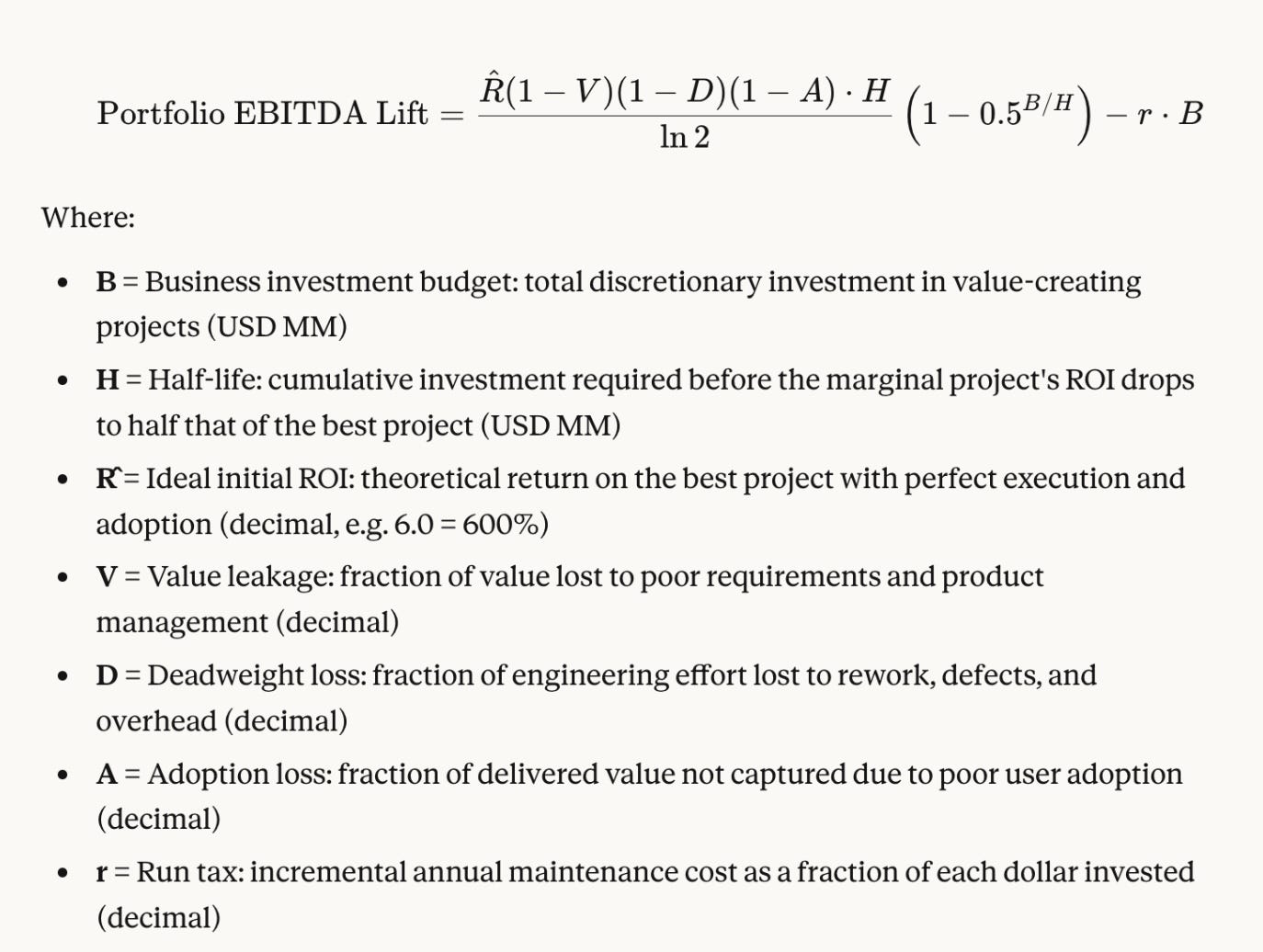
Don’t worry about the math — it’s just a mechanism for formalizing and integrating things we all know:
Companies face a pipeline of technology-related investment opportunities that you can sequence in order of attractiveness
Your portfolio and product management processes fall short of omniscience. Sometimes you invest in the wrong projects and sometimes you define the wrong requirements
Not every dollar of software engineering investment winds up “on the screen.” Your engineers suffer deadweight loss in the form of non-productive time, wasted effort and rework
Users don’t always use software well. Sometimes they refuse to use new systems. Sometimes they can’t understand how to use it well
Investments in new capabilities create a run tax that you have to pay year after year
Most enterprise technology functions have an aggregate budget, rather than investing down to the hurdle rate (where the ROI of the marginal project equals the cost of capital). At the highest level CIOs have to manage the following budget equation in any given year.
ET_cost = Bus_inv + Mand_inv_bus + Mand_inv_tech + T4T_inv + Run_cost [2]
In order to maximize EBITDA lift over time (while continuing to run the business at acceptable risk), CIOs must:
Reduce value leakage and adoption loss
Make T4T investments to reduce engineering deadweight loss, expand the range of attractive business investment, reduce run costs and reduce future mandatory investment requirements
Protect mandatory investments in order to avoid an unacceptable increase in risk to keeping the business running
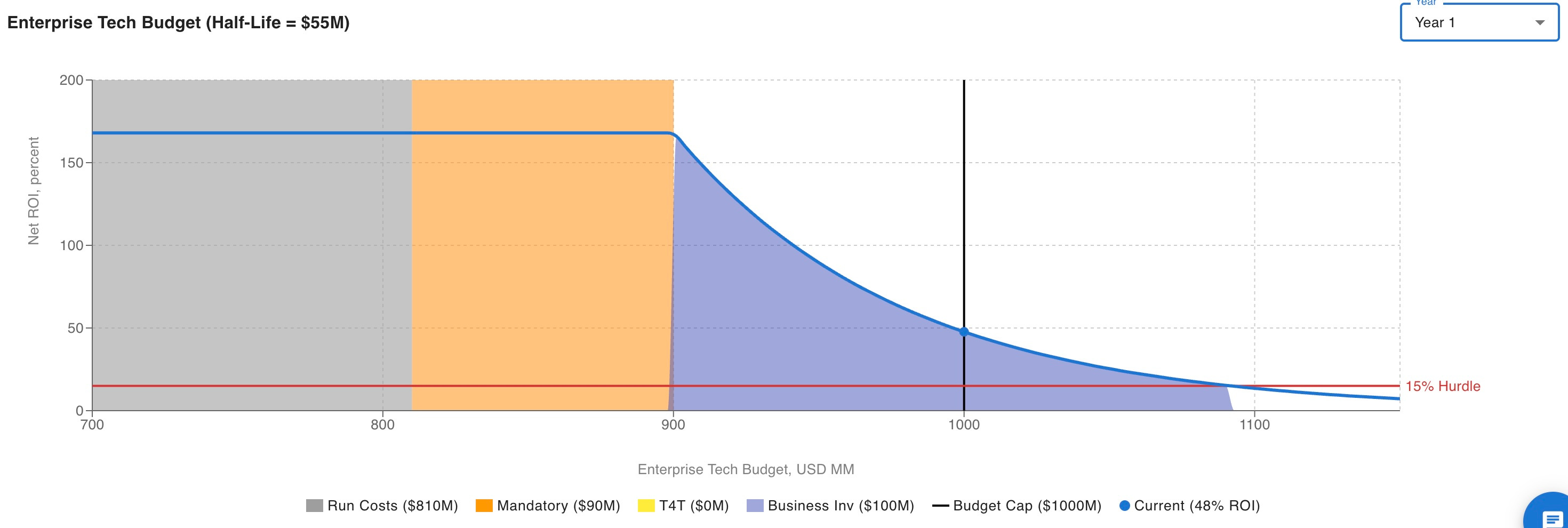
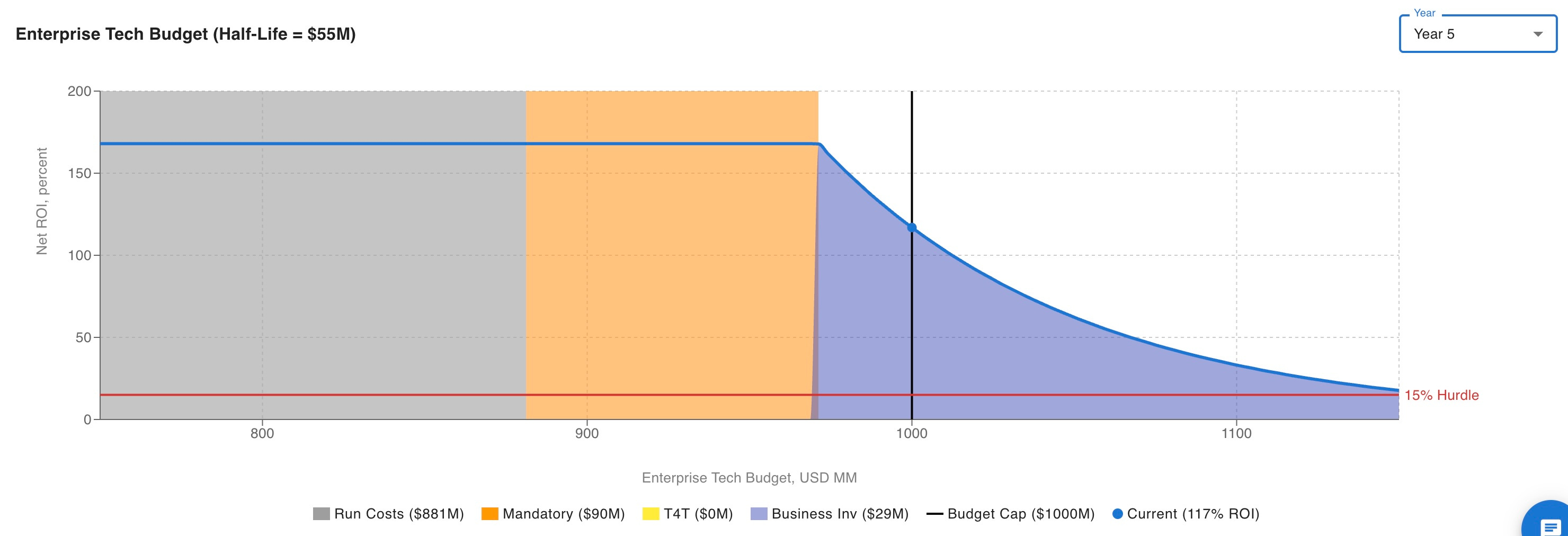
When CIOs don’t do this, enterprise technology functions can enter a “doom loop,” in which run costs increase, squeezing out both business and T4T investment. This creates pressure to cut architectural corners and take on more technical debt to meet business expectations, increasing the run tax on each dollar of business investment and accelerating the doom loop over time.
You can see this dynamic in these charts. Year 1 looks okay.
Year 5 is less attractive. Increased run costs and mandatory investments (inflated by investments in previous years) crowd out business discretionary investment and reduece EBITDA lift.
CIOs can’t increase EBITDA lift by themselves
Most of what CIOs must do to increase EBITDA lift, they can’t do without help — which they often don’t get.
Business unit and functional leaders have to engage thoughtfully about how technology intersects with their strategies to construct an intelligent portfolio — and they must mandate subject matter experts in their organizations spend time articulating requirements and user journeys
They also must create incentives for their teams to adopt new system capabilities and use them effectively
CIOs also need support from CFOs and CEOs in carving out space for T4T investments
This is a challenge. Only 13 percent of senior technology executives say they consistently get required engagement and support from their peers on the management team for the full set of activities required to maximize EBITDA lift, while continuing to run the business at acceptable risk levels.
Coordination costs make the relationship between enterprise technology and the rest of the business so fraught
In theory parents and children have a common interest. In the area of a restaurant that serves chicken fingers, small children have their own opinions on what constitutes acceptable behavior in public.
Coordination costs are high in enterprise technology
In theory, all the members of the management team only want to create economic value. In reality, companies face coordination costs in trying to govern enterprise technology, creating distrust and incentives for non-cooperation. Economists describe the challenges in getting different actors to cooperate as coordination costs. Enterprise technology faces a lot of them!
Information asymmetry. To reach their positions CIOs and CTOs have mastered a specialized body of knowledge in technology architecture and operations that their peers on the executive team cannot understand in depth. Likewise, CIOs will never understand the intricacies of a business domain as well as the people who run it. All of which creates opportunities for what economists call shirking, creating distrust. Were US Army generals who told the Clinton administration it would take weeks to relocate combat helicopters to Yugoslavia accurately describing logistical constraints or slow-walking a mission they didn’t believe in?
When a CTO says it will take hundreds of thousands of dollars to move an application to an external cloud provider, is she providing a fair estimate — or gold-plating an option she doesn’t like? When an operational manager says that his team can’t function without a complicated UI change, is that the truth, or a refusal to explain tradeoffs to his team?
Misaligned incentives. Enterprise technology teams steward platforms over years, sometimes decades. Business domain leaders often get paid to deliver against this year’s sales numbers or productivity targets. They want functionality that will help them meet their numbers now, not technical debt reduction that will make it easier to deliver functionality in the future, when they may already be on to the next role.
Conversely, business unit leaders may need investments in technology innovation to respond to market opportunities, but the CIO’s bonus may depend on not exceeding a top-line IT budget that leaves little room for deviations from plan.
Collective action problems. Most CIOs have asked themselves something like “Why do I have a different order capture system for each asset class?” or “Why does each therapeutic area have its own DTC system?”
Coordination is hard — it requires negotiation and compromise about business requirements. Nobody may want to go first in saying he or she can use a shared system rather than a bespoke one.
Lack of enforcement. There are no contracts inside a corporation. When a company buys a system from a vendor, the vendor has to support the system for some number of years, and the company has to continue to pay license fees for the duration of the contract. [x]
When a business unit transfers a system into enterprise technology, the tech team may provide the required support, but the business unit can’t know that. When enterprise technology accepts the system, the business unit may provide the funding in coming years to get the system “up to spec” in terms of security and resiliency, but the tech team can’t know that. All of which creates distrust and makes it harder to cooperate in a way that benefits the institution as a whole.
The result? Tension between business units and functions and enterprise technology
Technology officers often say that business leaders do not engage sufficiently in setting priorities or defining requirements; they focus on the immediate over the strategic; and they fail to appreciate technology risk. Business leaders say that enterprise technology leaders cannot explain their costs; they cannot innovate quickly; and they are hard to collaborate with. Everyone here is correct. Interviews conducted with senior enterprise technology managers show that only 13 percent say that their business counterparts exhibit all the behaviors required for capturing value from technology investments most of the time.
What frustrates CIOs and CTOs?
1. Insufficient engagement on priorities and requirements. Technology officers like to say they don’t do anything for themselves — they build and maintain systems to support businesses and corporate functions in achieving their objectives. Often tech officers say they do not get enough clarity on business strategies to prioritize investments, and they almost never get the quality of engagement on requirements they need.
2. Focusing on the short term. Building technology platforms is a long-term game. Systems can live for decades. Many large institutions depend on systems first implemented in the 1990s. Investments in flexibility today can provide massive returns in operating leverage in the future.
But tech officers say that their business partners often think in terms of quarters, not years. They prioritize immediate functionality over underlying capabilities, which take longer to deliver and are harder to value. The result? A vicious cycle. Technical debt increases, making it more expensive to add new functionality.
3. Mis-pricing risk. Scalability testing, high availability, threat modelling, cybersecurity controls, and disaster recovery are all needed to mitigate risk in enterprise-grade applications. Safety is expensive. But technology leaders are often frustrated that their business partners do not understand the full cost of security. Tech officers like to point out that business owners who resist investment in high-availability architectures or cybersecurity controls often shout the loudest about how the technology organization fouled up when a major incident occurs.
And what frustrates their peers in other parts of the institution?
1. Economic opacity. Large enterprises spent about $5.7 trillion globally on information technology in 2025, up 9.3 percent from 2024. [x1] Depending on the sector, Fortune 500 companies devote between 6 and 15 percent of their operating expenses to enterprise technology. [x2] Again and again, senior executives say they get pages of spreadsheets on enterprise technology spending, but technology officers cannot explain how spending aligns to business objectives, why technology costs as much as it does, and what the realistic options for managing spend might be.
2. Struggles with innovation. Business leaders say that the most radical innovations in their companies were often introduced at the edges, rather than by their main enterprise technology organizations. That’s because most enterprise technology organizations are set up to manage systems at scale but are less effective in evaluating and applying disruptive technologies. And this has become even more of a challenge as technology officers have to devote even more of their time to risk management, cybersecurity, and regulatory compliance.
3. Frustrating User Experiences. We all use freely-available consumer-oriented technology services every day — from YouTube to ChatGPT. These easy-to-use tools have trained us to expect delightful user interfaces, with professional graphic design, intuitive functionality, and an extensive threading of experiences across services from the same provider. We all go to work and experience something different with enterprise software: clunky design, hard to understand functionality, and limited integration across capabilities. The 20 minutes that a valuable employee wastes trying to decipher an incomprehensible screen? That doesn’t show up in any income statement — but it hampers morale and productivity.
4. Difficulty navigating technology organizations. Portfolio management. Architecture. Application development. Technology procurement. Infrastructure. Risk and controls. Cybersecurity. Enterprise technology is an empire to itself of seemingly arcane functions each with its own imperatives and terminology. Business leaders say their people struggle to navigate enterprise technology and that different teams do not coordinate with one another. This forces business leaders to play an integration role they are not suited for and do not particularly enjoy.
Game theory provides a path
There are many proposals about what CIOs and CTOs should do about the challenging political context they face. Most of the ones I’ve seen are politically naive — they either assume that good behavior will elicit cooperation or that they can convince the CEO to mandate cooperation by fiat, as a deus ex machina.
Several books recommend getting the basics right: reduce costs, improve service quality, invest in relationships. All necessary, but not sufficient — few of these books even acknowledge the structural agency and coordination costs, let alone offer any suggestions about how to surmount them.
Many CIOs fixate on reporting directly to the CEO. Sure, reporting to the CEO is nice, but many CIOs who report to the CEO still lack the cooperation they need.
Economists would say when faced with problems caused by agency and coordination costs, change incentives — but the executive team’s incentive structure is a finely balanced political mechanism. The CEO won’t want to relitigate it just to make the CIO’s life easier.
In the past I have suggested that CIOs take a page from civil-military relations and frame enterprise technology as a profession, in which business leaders set objectives and provide wide latitude for the enterprise technology professionals to achieve them. I continue to think that civil-military relations literature has a lot to teach us about enterprise technology governance, but getting there will take time. If you’re a CIO, marching into the CEO’s office with a copy of Samuel Huntington’s The Soldier and the State will not go well for you in most cases.
So what will work? Game theory attempts to identify how to achieve an optimal outcome when different players (often with imperfect information) have different incentives. CIOs and CTOs can use the principles of game theory to create an information environment that encourages cooperation. What does this mean?
Develop a granular view on where you need cooperation to increase EBITDA lift over time.
Many CIOs I know struggle to articulate how enterprise technology creates business value. This is understandable. Sometimes the most obvious questions are the hardest to answer. How does enterprise technology create value? If it doesn’t run, we can’t do business. If it can’t deploy new capabilities, we can’t introduce new products, new channels and new operational techniques. That’s true, but not useful in prioritizing where you need the most cooperation.
I’ve been experimenting with the equations above, in part, to try to quantify the relationship between executive cooperation on enterprise technology governance and business outcomes. There’s a big difference between saying “I need operators to show up for training” or “we are carrying too much tech debt” and saying:
We have a history where users have been slow to adopt new platforms. If only half the supply chain team uses the new platform effectively, that will cut the USD 50MM savings articulated in the business case in half
If we don’t improve software engineering and remediate technical debt, the funds available for new business investment will come down by 40 percent within three years
This provides granularity into the cooperation you need — because some things will impact multi-year EBITDA lift dramatically, and some things are nice to have.
Coolly assess the political dynamics across the management team.
Many CIOs see CEOs as inscrutable and fearsome. Many CEOs like to present themselves as inscrutable and fearsome. This is not true. With a few exceptions they have shareholders, debt-holders, boards and equity analysts to answer to. Some have activist investors seeking profound changes in financial returns. The street is a harsh taskmaster.
Many CIOs see business unit heads as sovereign over a vast commercial empire. Many business unit heads like to present themselves as sovereign over a vast commercial empire. In many cases, this is not true. Business unit heads often struggle to push fractious collections of local markets or lines of business to move in the same direction.
When they invest the time to collect political intelligence, CIOs and CTOs can demonstrate empathy about the constraints their peers on the management team face. This helps, though not so much as making proposals that might mitigate political problems rather than exacerbate them.
In some cases, I have seen global CIOs or CTOs propose lightweight SaaS solutions for smaller markets. This helped business unit heads sidestep complaints from country managers about expensive global overhead.
CEOs facing activist investors often seek to manage investment accounts carefully. But what if you could demonstrate how much investment in getting to AI-enabled software engineering would reduce deadweight loss? Might that be a good thing for a CEO to share with activist board members?
Present options with implications to force decisions.
In a recent podcast, my colleague Rich Isenberg explained that CISOs don’t have to reduce risk or even eliminate it — they should provide business unit and functional leaders with the information required to make intelligent tradeoffs between risk and return. The CISO should present himself or herself not as a regulator or a roadmap, but as a colleague who presents options. Again and again, I have seen CISOs defuse tension about cybersecurity costs by framing options that give other members of the management team tradeoffs between risk and cost.
This works far outside of cybersecurity. One Pharma CTO faced terrible criticism from the company’s commercial function about network costs. He decomposed network costs into services, each with a unit cost, a service level and a volume. He explained how the commercial function’s footprint and service level shaped its costs. He pre-empted questions about unit cost by showing the bill of materials for each service. Then he asked, “What choices would you like to make differently?”
The CTO wasn’t just being collaborative — he changed the question from “why are my costs so high” to “what actions would you like to take to reduce them?”
Create transparency on cooperation.
I have helped many CISOs prepare for board presentations. I recall one such interaction vividly, with a CISO for a company with a very glamorous board. How, he asked, could he develop a readout on the company’s cybersecurity program that would be meaningful to opera singers and retired elected officials?
In response, I asked: well, what do you want the board to do? We arrived at the conclusion that the board couldn’t do anything for him. It couldn’t increase his budget or directly change the behavior of the management team. But even so, nobody on the management team wanted to look bad in front of the board. So he started including leading indicators of cybersecurity posture (e.g., patch level) by business unit in his board update. The board didn’t mandate anything, but cooperation improved nonetheless.
Clausewitz talked about the “fog of war.” He never saw the fog of corporate America. Things CIOs and CTOs understand intuitively may be very fuzzy to their peers. Scale and complexity can obscure a lot of non-cooperation. Quantitative metrics shrink the space in which non-cooperators can hide.
Embrace “It’s not my fault, but it is my problem.”
When it comes to enterprise technology, some business unit heads demonstrate a lot of cheek. After years of insisting on siloed capabilities for each product area and resisting platform investments, they demand to know why they can’t easily get an integrated view of customer economics. In fairness, sometimes the pressure for fragmentation and technical debt came not from the business unit head, but from his or her predecessors.
Some CIOs feel honor requires them to explain the root cause of the problem. Front-line technology managers understandably find the implicit accusations demoralizing, after they’ve spent years trying to hold everything together via bailing wire and duct tape.
Psychologists have a wonderful expression: It’s not your fault, but it is your problem. CIOs and CTOs need to embrace this, because it diminishes the extent to which others can accuse them of defensiveness or passivity. CIOs do better when they move from explaining the reasons for systems frustrations to options for fixing them (with different tradeoffs between speed and cost, of course!).
Engage in signaling to build credibility.
As noted above, the massive information asymmetries between CIOs and CTOs and other members of the executive team get in the way of trust. Many hard-bitten executives may be skeptical given past technology innovations that have proved underwhelming (cough, RPA).
When a CIO or CTO talks about the potential benefits of agentic process redesign, a business unit head can’t know quite how thoughtful the folks in enterprise technology have been. Is this worth his team’s time to flesh out the business case? Can the internal organization really do this, or should he just use a vendor that promises a “turn-key” solution? Is it really smart to commit to green-dollar savings here?
The enterprise technology team can signal its seriousness by moving aggressively on using agentic technology to reshape their own organizations. Yes, they could be insincere, but at least they have skin in the game, which increases credibility with their peers.
Being a CIO or CTO is a tough gig because enterprise technology is a tough, complicated thing. You need cooperation from other members of the management team, especially to maximize multi-year EBITDA lift. Why don’t you always get it? Not because people don’t understand technology, but because what economists call coordination costs are high. A CEO who gets religion on technology (probably) won’t save you, so you have to assess the economic and political realities and use the lessons of game theory to create incentives for cooperation.
Footnotes
[1] Yes, we could say operating income lift or cash flow lift, but we’ll use EBITDA lift here for simplicity’s sake.
[2] Some notes on the model and its simplifying assumptions:
Mandatory business investment includes addressing regulatory mandates, e.g., GDPR, Card Act, CCPA, etc.
Mandatory technology investment includes remediating end-of-life software and maintaining cybersecurity posture.
For the time being the equation assumes a constant risk appetite, with investments required to maintain posture against this appetite. Will probably enhance it to model discretionary “tech risk” investments that might change risk posture, given a changing risk appetite.
Right now model treats business platform investments (that might create performance improvement for multiple business units or functions) as just another form of business investment. Will think about if there’s an elegant way to break this out.
Also will think about modeling investments that create option value, e.g., data platform that might expand the range of valuable investment in future years
[3] Yes, contract enforcement is not costless. Yes, some technology vendors are very clever in the way they write contracts. But enforcement mechanisms (however imperfect) still exist.
[4] “Gartner Forecasts Worldwide IT Spending to Grow 9.3% in 2025,” Gartner, October 23, 2024
[5] Computer Economics, Avasant Research
Super engaging read!