

Merry Christmas! Happy Hanukah! Happy New Year! Happy Boxing Day! Happy Everything! This is the last Prosaic Times of the year -- next issue will be Sunday, January 4, 2026.
This issue explores the dialectic between elegance and effectiveness. The CIO’s desk section tries to ascertain whether classically good writing style creates documents and other business communications that win in the cognitive domain. The backlog includes an old story from the 1990s about how I tried to make a DOS-based GUI fast by making the code elegant. And the wire section raises the question about whether users really prefer graphics or whether good text is better than good enough?
From the backlog
Why don’t technology revolutions happen? Ask the interbellum British Army
My greatest coding triumph -- making a DOS GUI fly on a 286 in 1993
The CIO’s desk: Can Moneyball for business writing produce victory in the cognitive domain?
The takeaway
Documents as a business problem: Executives and managers (and many professionals) spend half their time creating and consuming documents (e.g. RFP responses, regulatory submissions, etc.) -- but what if the documents aren’t any good?
The cognitive domain and writing for frisson: In the AI age, information is cheap, but attention is dear. Effectiveness in the cognitive domain -- between the eyeball and the cerebral cortex -- separates success from failure. Effective writing provides a dopamine by forcing the the reader to slow down, solve the puzzle, and remember the point -- and you can measure this quantitatively.
A CI/CD pipeline for documents: “Ask Joe for that data. Ask Sally to read this” is an archaic process. Enterprises can learn from media organizations and create DocOps toolchain that use knowledge graphs, vector search and agentic processing to assemble and quality-control documents on the fly.
Moneyball for business communications: If you combine analysis of writing style with a DocOps tool chain you may be able to communicate in a way that drives success in the cognitive domain.
What if I’m wrong about the impact of good writing style?
In Sunday night’s issue I talked about how technologists could write more effectively. What if I’m all wet?
I offered a set of recommendations based on my own experience, based on advice I have received from people I considered good writers and books about writing. What if I’m like one of the out-of-touch old scouts in Moneyball, evaluating outfielders based on aesthetics rather than potential for wins-above-replacement?
More importantly for CIOs and CTOs, some pretty important business processes -- like constructing RFP responses -- depend on effective writing. Companies pay executives and managers a hell of a lot of money to create documents. A recent survey sponsored by Grammarly showed knowledge workers spend 19 hours per week on written communications. An older analysis by IDC showed knowledge workers devoted an even larger fraction of their time to producing and consuming documents.
You’d like to think they could be better at it. In a world where AI provides much easier access to information, the strategic battleground is the cognitive domain, the space between people’s eyeballs and the cerebral cortex. You could argue that social media companies and other digital giants have derived massive economic returns by operating in the cognitive domain in some B2C markets.
Is it possible to imagine Moneyball for business writing? And if we have pipelines and toolchains for software engineering, can we imagine a document pipeline and toolchain that creates planning documents, pitch decks, RFP responses and regulatory submissions that the audience for those documents finds compelling? [1]
Is good writing effective writing?
In Sunday’s issue I pointed out that received wisdom tells us the rhetorical devices like schemes and tropes increase reader focus therefore retention. When Ted Sorensen wrote, “ask not what your country can do for you—ask what you can do for your country” his use of an antimetabole burned into national memory. 2 It seems stylistic variations like (schemes and tropes) cause a moment of intellectual frisson. The reader slows down for a moment to understand what is going on, and then receives a little hit of dopamine for solving the little puzzle the author has left in the text.
There is a limit here to the level of intellectual frisson you want -- that’s why Henry James and Judith Butler are incomprehensible. Experience from advertising indicates, unsurprisingly, an inverted U, just enough complexity to surprise them, but not enough to impede understanding. Much of the challenge in writing involves guessing how much complexity puts you at the top of the inverted U, given audience and topic.
Can we analyze writing even more deeply in hopes of understanding its effectiveness? As noted on Sunday, academics at University College Cork used stylometric analysis to discern LLM-generated from human generated prose by looking at markers like sentence length and word choice. I asked an LLM to apply stylometric analysis to recent Prosaic Times articles.
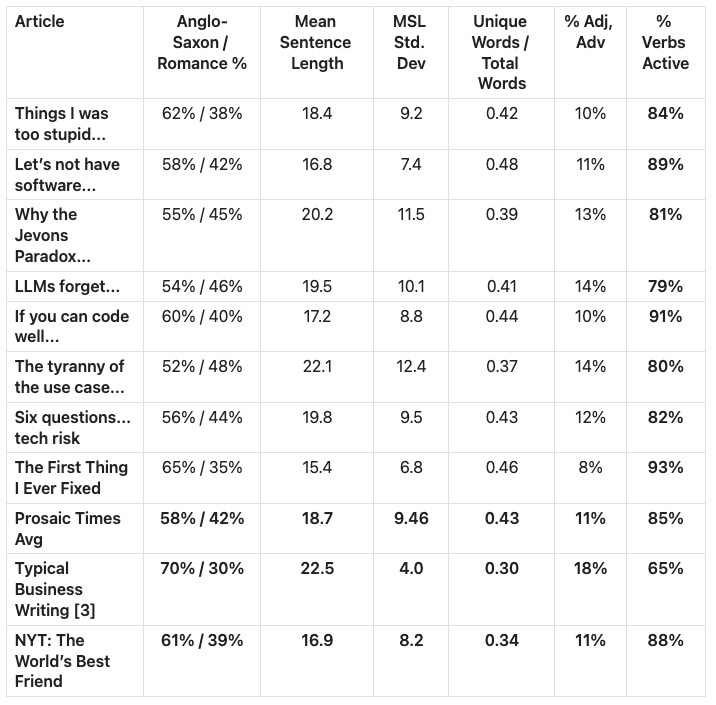
What does this tell us? I use many Latinate words (especially nouns) for precision and few modifiers. I use a lot of active voice. A high ratio of unique words to total words indicates a breadth of vocabulary. And a higher standard deviation in mean sentence length indicates a degree of rhythm. At least I take my own advice, but does any of this matter?
Maybe. Our brains appear to carry evolutionary wiring for the subject-verb-object template, so passive voice increases cognitive load, making reading a passage less pleasant, taxing working memory and diminishing recall. The Von Restorff effect predicts that we will remember a stimulus that differs from adjacent ones. So when you follow several long sentences with a short one that crystallizes your point, the reader will remember it. [4]
Some researchers have started to look at how language affects book sales and which content goes viral. Researchers have also started to investigate at which type of writing leads to more successful proposals.
Media companies (media companies!) have taken the lead here
When I ran the Brown Daily Herald, we knew as much about what our readers read as any publication on Earth -- because we used to walk around the dining hall at breakfast and look at which stories spent time on. [5] We also had a story pipeline as part of our production process that astonished journalists who worked at grown up newspapers [6]
Media is very different now. Not only do they know who opens their stories (based on clicks), they also measure the “dwell time” a reader spends on a story -- and started to charge their advertisers for it. Not only have they prioritized reporting and frame stories around what readers want, they also have started to edit stories to maximize dwell time. For example, the Telegraph discovered that readers would often “bounce” halfway through stories, so they have started to inject rhetorical hooks and vivid imagery in the middle of a piece.
As early as 2014, CA Technologies executive Jim Turcotte started to talk about DocOps, which applies collaboration, integration and continuous delivery to content creation, creating a documents-as-code model. News organizations started to automate prepress processes. The Washington Post’s Heliograf system ingests structured feeds (e.g. sports scores) and turns them large numbers of short articles. Back during the 2016 Rio Olympics, Heliograf published more than 850 articles, cutting time-to-publish to under a minute, increased click-through by 12 percent and allowed redeployment of 30 reporters to investigative journalism. During the 2018 elections Heliograf allowed the Post to update vote tallies every 30 to 90 seconds. The Financial Times‘ Lantern system is a CI/CD pipeline for content -- it allows the paper to build tailored experiences for different platforms and readers using “atomized content.”
But what does this mean for other types of enterprises?
The RFP responses, regulatory submissions and strategy documents management teams produce and consume differ structurally from the content media companies produce. Volumes are lower -- you don’t complete 850 RFP responses or strategy documents in a few hours. Documents are typically longer and more complex than news stories. And you don’t have any single, easy-to-capture metric of commercial effectiveness like dwell time.
As a result, the process for things like RFP responses and strategy documents lies between “Ask Joe to send you the product quality analysis we used on the OldCo deal” and “Have Sally read through this before you send it to the CFO -- she knows what he likes.”
And yet, maybe this is another area where AI allows us to think about the problem differently than we would have even a couple of years ago? What could Moneyball for business documents look like?
Systematic capture of relevant performance metrics. Some RFP responses succeed; some don’t. Some pitch materials lead to a follow-up meeting; some don’t. Some planning documents resolve an issue quickly; some spin into endless iterations. With not too much discipline, you can capture all this data.
Curation of atomic content. Every company sits on an ocean of unstructured data sitting in vertical documents, presentations, spreadsheets, and even emails. How does this data move from existing documents into new documents? Mostly a Ctrl-C/Ctrl-V keystroke combination. This doesn’t have to be the case any more. You can use vector search to extract relevant information from endless file stores, use GenAI to apply meta-data and store it in a knowledge graph for ready, repeatable access.
Programmatic document assembly. How many years ago did we start disentangling systems into data, logic and presentation layers? 7 Most companies continue to store critical data in the “presentation layer” -- word processors and spreadsheets? Some are building agentic systems to construct documents like credit decision memos in real-time. Think of it as dynamic binding for documents!
Linguistic analysis of effectiveness. If companies start to track document effectiveness, and they start to apply stylometric analysis to their documents, they can develop a view of what type of writing produces victory in the cognitive domain for them. Do they need shorter punchier sentences in the executive summary? More vivid imagery when in product descriptions?
You could even imagine companies applying this type of model to less formal communications. Which emails resolve an issue quickly? Which ones create long chains, in which various participants fruitlessly request clarification of one another?
I would hypothesize that classically good writing style prospers in many situations. It provides clarity and signals respect for the reader. It coheres with learnings from modern psycholinguistics, even if it predates those by millennia. But market effectiveness trumps my aesthetic preferences.
The question is whether companies can combine learnings from media organizations, knowledge graphs, agentic processes and LLM-enabled linguistic analysis to play moneyball and create documents that produce victory in the cognitive domain.
The wire section: what I have been reading watching and listening to
2025 LLM Year in Review, Andrej Karpathy
By the way, I expect everyone has seen @karpathy’s year in review
There is one passage I might take issue with: “Text is the raw/favored data representation for computers (and LLMs), but it is not the favored format for people, especially at the input. People actually dislike reading text - it is slow and effortful. Instead, people love to consume information visually and spatially and this is why the GUI has been invented in traditional computing.”
I’m not entirely sure this is true, or least true for everyone. Most professionals both consume and produce scads of text. In many cases, you can at least produce text much more efficiently than you can produce graphics.
CLIs can be better than GUIs at least if you know what you’re doing
I wonder if LLMs might return us to a textual world after an unfortunate detour in GUIs
From Airline Reservations to Sonic the Hedgehog, A History of the Software Industry, Martin Campbell-Kelly
Continuing to work my way through this, and it continues to show there is little new under the sun. Software companies of the late 1960s sought to move from building bespoke software under contract and selling products to offering utility-type services. They were ahead of the market by decades!
“Each of these firms had effectively bet its survival on the emergence of the computer utility. This concept was always somewhat nebulous, its exact meaning depending on who was doing the promoting. In essence, however, the idea was that eventually users would own neither computers nor software; they would run applications software on remote machines through private or public data communications networks.
“Fortune enthused: Some computer industry prophets regard the service bureaus as the key to the industry’s future. The computer business, they say, will evolve into a problem-solving service. What they envision is a kind of computer utility that will serve anybody and everybody, big and small, with thousands of remote terminals connected to the appropriate central processors.”
The arrival of minicomputers in the late 1960s put paid to the software companies teleprocessing aspirations. Medium sized firms preferred owning their own computers to buying remote computing services -- this became apparent only after huge investments by computer services firms.
Footnotes
[1] The cognitive domain is less fraught in B2B markets because you have sophisticated buyers transacting with sophisticated sellers.
[2] I used a bit of a rhetorical trick there illustrating foregrounding. Almost everyone knows that President John F. Kennedy used that line in his 1961 Inaugural Address. Fewer know that Sorensen wrote the speech. So seeing Sorensen’s rather than Kennedy’s name above causes the readers mind to ask “Hey, wait a second -- what’s going on here?”
[3] Sources for estimate of typical metrics for business writing:
Anglo-Saxon/Romance: Williams, J. M. (1990). Style: Toward Clarity and Grace. Based on etymological analysis of “Corporate-speak.”
MSL: Gunning, R. (1952). The Technique of Clear Writing; Plain English Campaign (PEC) standards. Calculated as the average word count in “Standard” professional memos and reports before clarity intervention.
MSL Std Deviation: Crossley, S. A., et al. (2011). Predicting text coherence using LSA and word frequency. Extracted from studies on prosodic variance. Corporate prose is noted for its “rhythmic regularity” (monotone), typically showing a variance of <5.0 words
Unique Words/Total Words: The Brown Corpus (Genre: Professional/Governmental).
Percent Modifiers: Vande Kopple, W. J. (1985). Metadiscourse. Business writing uses “hedging” (possibly, somewhat) and “boosters” (very, critical) at a rate 1.5x higher than technical documentation.
Active Verb Percentage: Ferreira, F. (2003). Cognitive Psychology; HBR (2014) “The Active Voice is Actually Dynamic.” Derived from stylistic audits of Fortune 500 annual reports and white papers.
[4] I could spend months going down a rathole on the intersection of writing style and psycholinguistics
5 Also in a small community, people tell you what topics they are interested in. We published a story on parking one day. Every member of the editorial board heard from at least one professor something along the lines of “Great story on parking, but you’ve only scratched the surface.” Every demographic has a topic they obsess over -- for faculty it’s parking. Yes, the Brown University administration has an untapped lever here to influence faculty behavior if it so chooses.
[6] We get a file on floppy disk in MS-Word, strip out all the extraneous tabs and carriage returns, apply a standard set of styles and upload onto the AppleShare server. After a couple of rounds of editing, the night or section editor would ingest the story into Aldus PageMaker for layout. (I named the Herald’s touch football team the “Fighting PageMakers.” Our record against the Harvard Crimson was pretty good. We also used to beat the Brown Undergraduate Council of Students in softball.)
PageMaker maintained live links with the original word file, so we could do layout in PageMaker and edits in Word in parallel -- and then tell PageMaker to update the link. A reporter visiting 195 Angell Street to use the fax machine nearly fell over when he saw how quickly we could get a story into the paper when we needed to.
I didn’t understand his astonishment until Matt Wald took me on a tour of the NY Times building as I saw how they did prepress. Reporters wrote and editors edited stories in an Atex “cold type” minicomputer terminal. Then former linotypists composed pages with X-acto knives by pasting down long strips of Atex output on flats.
[7] As noted in the link, John J. Donovan played an instrumental role in developing and evangelizing the idea of a three-tier architecture. I saw him speak when I did second round interviews with his company Cambridge Technology Partners in 1992. I didn’t get a job offer, and I couldn’t understand the company’s business model when Donovan described it.
Wow — this resonates. I see the same pattern when writing Incident Reports for major application outages. The structure, framing, and level of detail directly affect accountability, learning, and downstream decisions. A true “DocOps” layer—standardized, outcome-aware documentation across incident reports, meeting notes, and internal docs—could realistically save millions of man-hours across large enterprises while improving decision quality, not just efficiency.
Seriously—so elegantly written. When I hit “Documents as a business problem…,” I grabbed some green tea and read the whole thing at a slow pace. Thank you!