

From the backlog: an interrogation of whether technology is a profession and why CIOs and CTOs should be inner-directed
The main argument: 25 years of learning about profession and craft in McKinsey’s technology practice
What I’m reading, watching and listening to: The craft that my former colleague put into writing a play…that got produced
From the backlog
Here’s a few items from the backlog you might find interesting.
Advice for this years grads: don’t wait for permission; just do the thing
If you don’t devour history, you have no business calling yourself a strategist
The main argument: Things I was too stupid to know when I joined McKinsey’s Technology Practice — and how AI changes that
Last year, having spent two and a half decades at the Firm, I drafted a note for Padawans reading the Tech Office Update about what I had figured out in that time. They might learn from someone who had made every mistake anyone had ever heard of, plus a few nobody would have thought possible. I can be very creative. My learnings reflect the arc of my career — from gettin the analysis right, to increasing my personal productivity, to becoming more strategic, learning how to collaborate and lead and, finally, figuring out how to make my career more meaningful and sustainable.
Please share this article with friends or colleagues who might find it interesting!
The Autopilot podcast I did with Will Summerlin helped me understand this. When he asked what I had learned in my career. I replied that, at first, I really cared about facts and analysis and thought the best answer should win out. That was stupid because people are not Excel models — they have aspirations and interests we need to understand and address.
As I thought about sharing this with a broader enterprise technology community (because all the same lessons apply), I also asked myself: how much does this change, given the advent of GenAI?
Everything I wrote still holds. The logic of strategy is still paradoxical. Large organizations are still bewildering. And the people who inhabit them are just as emotional, idealistic, cynical, and bullheaded as they were a few years ago.
But technology innovation changes terrain—so there are a few additional things that the wizened old heads of 2050 will tell their juniors.

Getting to the answer
Very quickly, I learned how to focus on “the answer” — there are no good outcomes unless you understand why costs are high or why and application keeps falling over. How could I cut through the uncertainty, political agendas and incomplete data to figure how to architect a system, redesign a process or make an organization more efficient?
The truth is the easiest thing to remember
David Mamet is perhaps the greatest living American playwright. He tells us, “Always tell the truth. It’s the easiest thing to remember.”
Sensitivity, even “reading the room,” matters, but we owe the people we work with the truth. You must be willing to level with the people around you and let the chips fall where they may, even if it means getting yelled at. David Maister wrote a whole book on the trust equation: trust = (credibility + reliability + intimacy) / self-orientation. Careers are built on trust, and there is no trust without credibility.
If your mother says she loves you, check it out
People lie in business, just like they lie to journalists. They want to protect themselves. They want to advance an agenda. They want to sound important. That’s why grizzled old editors tell cub reporters “If your mother says she loves you, check it out.”
The truth is typically hard to get at and often fuzzy, but unless you get to the truth, nothing else matters in business or technology. Effective technologists must be post-positivists, aware of the difficulties and the fuzziness, but committed to getting as close to the truth as we can. That means cross-checking assertions, even from people we trust, with hard data or with other perspectives.
Lying in generalities is easy. Lying with specifics takes creativity and effort. Probing for details can be a quick way of “checking it out” – ask: Can you give me a specific example of that? When did it happen? Who was involved? What was the impact? Mendacity and evasion rarely survive the “five whys,” in which you keep asking questions until you get to ground truth.
Passive voice is unhelpful, and I don’t know anyone named “they”
Sometimes colleagues will tell me “It was decided that…”. Who decided? Elves? A platoon of malevolent war otters? Fred from accounting?. This is morally sloppy as well as stylistically unfortunate. Things don’t just happen. People do them. We can only sustain constructive actions and unwind unproductive ones if we know who is responsible.
Nowhere is this more dangerous than in a Root Cause Analysis (RCA). The patch was applied without testing. Patches don’t apply themselves — who applied it. Passive voice hide liability, and it prevents us from fixing the problem.
Ask every question
Embarrassingly, I didn’t know a blasted thing about cybersecurity in 2011, but I am a curious person. So I talked to everyone who seemed to know anything about the topic and kept asking questions. Eventually, learned enough to write a book.
I tell new associates that they ask every question of anyone who will spend a few minutes with them. Some of the answers may not even be right, but you still learn about the range of opinions people have—and which perspectives make sense to you versus not.
Sometimes questions can be naive or annoying, but not as often as you might fear. People love to explain their work and share their opinions. And over time, you develop the skill for making your questions less naive—or at least knowing when and how to acknowledge your naïveté.
And always ask for the underlying data
Years ago, columnist Megan McArdle dug into the discourse saying there is no tradeoff between raising the minimum wage and growing employment. She read the studies: they showed no job loss in the short term for small increases in the minimum wage.
Last week I wrote about the discourse on repatriating applications from the cloud. Barclays said a study they did showed 83 percent of enterprises would repatriate applications from the cloud. But they didn’t say how many applications any enterprise would repatriate. If a large bank moves 1,000 applications off-prem and then migrates 3 or 4 back because they didn’t remediate them appropriately, is that a substantial pullback from cloud?.
Every study has boundaries in its scope. Survey responses depend on the wording of the survey instrument. Always ask for the underlying data when it’s important.
Being productive
After a couple of years, I figured out that I couldn’t just outwork every problem. I still needed to get to the truth, but more efficiently, in part by interrogating my own working style and figuring out how and when I was wasting time, or at least not working well.
Work in Chunks
Years ago, I worked with a very brilliant colleague (who now runs a hedge fund) who couldn’t deliver quality written materials in any reasonable timeframe. Confused, I asked him how and when he worked. He explained that he waited until he had a block of several hours to work on a presentation and tried to complete it in one sitting. I explained to him that this made no sense and that he should try working in smaller chunks of time:
Smaller chunks of time are easier to find, so he could start sooner.
Chunking up the effort allowed his subconscious mind to work on the problem—sometimes creative ideas appear when you don’t think about a problem.
Counting on getting the materials done in one sitting creates pressure, which makes creativity harder
Writing is mentally taxing—you can’t always count on sustaining focus on one task across several hours.
Life is an experience curve
People ask me how to improve the speed and quality of their writing. I say: write more. I’m a better and faster writer than I was two years ago because of the tens of thousands of words I’ve written (internally) for the Tech Office Update and now for Prosaic Times.
You want to code better? Write code. You want to get better at interacting with business partners or customers? Go to more meetings with business partners or customers. This will be uncomfortable. We will make mistakes. We will embarrass ourselves. And we can learn from these painful experiences and get better.
But you also have to be thoughtful here: what is it you want to get better at? How do you make sure you invest your time on the activities that will push you down the experience curve you want to transit?
Thinking strategically
As I progressed in my career, I learned (sometimes rather painfully), that analytical insight, even when achieved with high productivity, only takes you so far. I had to learn how to think strategically — to move from thinking about “where to go” to thinking it terms of “what are the barriers between hither and yon and how do surmount them?”
Strategy is integrative, non-linear, and paradoxical
Michael Porter made generations of business leaders less smart when he told them strategy is what to do; tactics are how to do it. This implied a functional, unidirectional relationship between strategy and tactics. First you figure out what you want, and then you let subordinates figure out how to execute. Which would be great in a world with unconstrained time and resources. B.H. Liddell Hart is more helpful: strategy is the linkage between ends and means—deciding what to do depends on what you can do.
I like the old definition of strategy as the work of generals best of all. Traditionally, a general officer commanded multiple types of formation: infantry, cavalry, artillery. So, strategy is inherently integrative and therefore non-linear. Take one piece of the puzzle away and the enterprise degrades not by 20 percent; it falls apart. Finally, when Edward Luttwak said strategy is paradoxical, he meant we like to do easy and low-risk things, but competitors will do these as well, so they yield no strategic advantage.
Be analytical about the emotional
Whether it’s a war or a decision about approving a cloud migration business case, at the the highest level, strategy occurs in your counterparty’s mind. By early 1945, Imperial Japan had objectively lost the war; it had no way to achieve its war aims, but it continued to fight nonetheless. After Nagasaki, it could still have fought on, and probably would have if the allies had not abandoned their demand for unconditional surrender and agreed to the preservation of the Chrysanthemum Throne
A college acquaintance advised Richard Holbrooke in negotiating the end of the war in Yugoslavia, often sitting in the room as Holbrooke bargained with Slobodan Milosevic. Despite the acrimony, Holbrooke always offered Milosevic a “climb-down,” some emotionally important concession that channeled him toward a deal. Likewise, allied leadership thought hard about Japanese motivations and constraints. They were ruthlessly analytical about their counterparty’s mindset to bring the war to a close. Fortunately, CIOs and other technologists don’t have to figure out how to close out wars, but we engage with people who may have a wide variety of objective functions and constraints—we get nowhere unless we understand these well.
Embrace Fingerspitzengefühl
Through much of the Great War, both Central Powers and the Allies launched huge set-piece battles, preceded by days of artillery bombardment on the Western Front. The bombardment both gave defenders time to prepare and chewed up the battlefield, making it hard to advance. Generals traded hundreds of thousands of lives for progress measured in yards. Eventually, both sides adopted infiltration tactics, sometimes described by fingerspitzengefühl, in which they probed enemy lines for weak points before reinforcing success.
How often do we see technologists resemble the generals of Passchendaele, making “big bets” on favored technologies?. Far better to try different things, see what resonates and (critically) reinforce success. You try different things to see what works, not to let every mid-level manager pursue his or her idiosyncratic choices. Heck you could argue Passchendaele is waterfall and fingerspitzengefühl îs agile.
Read widely
Someone once asked me whether there were many ways to run a good help desk or just one. I replied, evoking Tolstoy, “Happy help desks are all alike; every unhappy help desk is unhappy in its own way.” Only one person on the videoconference chuckled.
Yes, I have an odd, sometimes off-putting sense of humor. But reading interesting things, even things far afield from your direct responsibilities, makes you a better technologist and professional. That line from Anna Karenina reminds us that things can go sideways in more ways than they can go well—an important insight for anyone who has ever tried to fix a shoddy help desk. Yes, reading provides us with directly useful information (about best practices in context engineering, for example), but it also provides us with orthogonal data points and perspectives that increase our creativity and improve our judgment.
Analysis informs rather than determines decisions
Please do not interpret the comment above as either support for or opposition to raising the minimum wage. The factual question of the relationship between minimum wage rates and employment levels is separate from the values question of how to make tradeoffs between wage rates and employment levels. Being a super-curious guy, I love analysis; I love doing it, and I love reading it, but analysis only gets you so far.
At some point, you reach questions for which the relevant facts are thin and decisions depend on what you value. There is no analysis anyone can do to prove how much cybersecurity is enough protection or when accelerating a project timeline becomes too risky. Decisions like that depend on judgment, informed by analysis.
Collaborating and leading
Analytics and strategy came easily to me — collaborating and leading, less so. Through the course of more than a couple of career crises, I learned that just figuring out the right objective and even the right course to achieve was only so valuable. You have motivate the people around you to pursue an objective.
To influence, you must be open to influence
I once had the privilege of helping former RSA Chairman Art Coviello with an initiative to improve collaboration across different stakeholders on cybersecurity and technology resiliency. As you can imagine, large enterprises, law enforcement, technology vendors, privacy advocates and the national security community all had very different interests, perspectives and assumptions on this issue.
Art taught me that we needed to help those involved progress from debate, to discussion to dialog.
In debate, you seek to marshal facts and logic to bend your opponent to your logical will.
In discussion, you exchange information with another party, in hopes of pursuing a common goal
In dialog, you and others expose your assumptions in the pursuit of finding common ground
This was fascinating to me. I admired John Stuart Mill who said we needed to get the arguments out there and the best ones will prevail. But the world doesn’t work quite that way. Nobody is a fully rational debate. We have assumptions and interests — and getting agreement on a strategy often requires understanding and being open to others’ assumptions and interests. Not everyone is an adversary.
How you talk matters as much as what you say
Years ago, a friend and colleague received feedback that he needed to improve his verbal communications and he should work with a communications specialist. Not sure about this, I watched him very closely in the next few meetings.
I told professional development that this colleague needed help from a speech pathologist, rather than a communications specialist. A transcript of what he said would look great—on point, structured, clear, and specific. But he spoke in a monotone, making it hard for listeners to understand or remember his points.
Speaking has topography, and listening to a monotone is no less unmemorable than driving across a flat, empty prairie. I sat with this colleague, listening to Winston Churchill’s great speeches during World War II. We sat in a prosaic midtown conference room Youtube playing the “Blood, toil, tears and sweat” speech, a printout of the text laid next to the laptop. Lost in wonderful rhetoric, wonderfully delivered, watching how Churchill varied his volume and pace and stressed certain syllables to underscore his message. You can almost imagine Britons leaning forward towards the radio as Churchill lowered his voice and then sitting straight up when the First Minister to the King emphasized a point with volume.
Yes, technologists must know something, typically many things. But they must also move people—to invest in a business case, to adopt a new technology, to keep slogging on in building a platform to accept feedback. Timbre matters, especially in the context of the task. When presenting a large-dollar business case, the audience wants to hear confidence. When providing feedback (or coaching) to a struggling junior, he or she wants to hear intimacy and empathy.
I can fix (almost) all the problems I know about, and none of the ones I don’t know about
I can’t stand the old saw “Don’t bring me problems. Bring me solutions.”. If you have a solution, what do you need me for? Go implement it yourself. More importantly, most problems don’t get better with age. I would rather know about something right away so I can help fix it before it becomes a bigger problem. Sometimes people come to me with something after stressing about it for two weeks, and I can solve it with a text message. Waiting two weeks in those cases was just inefficient and painful.
Your chore is somebody else’s opportunity
We all get asked to do important but unexciting things. Lead this project. Present at that offsite. Attend one conference or another.
Once I got asked to lead a session on data center efficiency. It was important, but I had already demonstrated I could do something like this a dozen times. So I called an earlier-tenure colleague I had mentored on IT infrastructure. He was thrilled. He was trying to demonstrate his expertise. I prepped him, and he did great. The session would have been a chore for me, but it was an exciting opportunity for him.
What are the tasks that have to get done—the business partner meeting, the new technology to explore—that you just don’t have the energy for? Is there some junior colleague who would consider the task an opportunity for growth and career development?
Never confuse coaching and feedback
Feedback is about what. Coaching is about how. “Dusty, if you can’t get your batting average up to .275, we’re going to send you down to Triple-A.”. You can imagine Dusty thinking, “Really? I should improve batting average. Wanting to do that never occurred to me.”
What does coaching look like? “Dusty, you look a bit stiff in the box. I want you to try setting up with your hands half an inch lower as you wait for the pitch” is coaching. It’s actionable and therefore helpful.
When others told my colleague he needed to improve his verbal communications, they were giving feedback. When I diagnosed the root cause (a monotone) and helped him think about how to fix it (by listening to Winston Churchill!), that was coaching.
It’s easy to provide too much feedback and not enough coaching. When providing advice to a younger colleague, always try to think through root causes and actions to address them. What specifically should he or she say to senior business leaders to be more credible? What data should he or she look at to improve system resiliency?
Don’t just do something; stand there
I was the lowest-talent walk-on, target-practice keeper in the history of Brown University’s soccer program before Coach Starsia rightfully cut me sophomore year. I was short, near-sighted, and had lousy hands. If somebody was going to crack a rib in practice, that was supposed to be me, rather than anyone who might ever play in a varsity match. Steve had been one of the best high school strikers in Texas. He was supposed to be the goal-scoring future of the program.
Yet I had Steve’s number in scrimmages. He would start a breakaway and come at me, expecting me to come off my mark so he could break left or right and put the ball around me. But I never did. I stood my ground; Steve drilled the ball into my chest and erupted into profanity. We all like action, but action doesn’t always help.
It took me many years to learn that this applies just as much in a business environment as it does on a soccer pitch. Sometimes that extra phone call to a business partner about a business case just annoys her. Sometimes that email to a colleague explaining a course of action reveals more than he is ready to assimilate. Sometimes you just must wait.
Building a career and staying sane
Finally, I became more thoughtful about my own career, and started asking questions of myself. What motivated me? What increased or reduced my stress level? Where did I want to take my career, rather than just proceeding from one challenge to the next?
Become inner directed
I was a very outer-directed person when I was younger. I cared a lot about externally provided measures of accomplishment and success. I worked really hard in high school (well, sort of) to get into an Ivy League college, and then I worked really hard to get into a top-tier business school. You get the picture—the acceptance letter from Wharton meant a lot to me.
Eventually, I realized that’s a really stressful way to live. You can control what you do, but you can’t control what anyone else will decide. You can become inner-directed—decide what you want to accomplish and then measure yourself on what you have done, rather than what people think about what you have done. It’s a hell of a lot less stressful way to live.
Context matters in managing mental state
Mental state impacts our creativity, our rationality, and our ability to inspire or at least collaborate with others. Time, place, and company affect our mental state a ton. I am least mentally engaged between 4 and 6 pm. I like to be around other people when I work. I struggle to write creatively when facing a wall. Incurious people drive me up a wall.
I try to use this self-knowledge to manage my day. I spend time reading, thinking, and writing early in the day—at the coffee shop!—and try to work out in the late afternoon. And I do everything I can to spend more time with curious people. None of us can control context all the time. I have lots of meetings when I need to be “on” at 4 pm. But even understanding contextual stressors reduces their power—something you understand impacts you less than a general sense of discomfort.
You work at a company, but for yourself
I served as a guest teacher for a seminar with a gaggle of Brown University CS students recently. They were anxious about managing work-life balance. I tried to explain we’re not coal miners. There is no linear relationship between mental load and number of hours per week. Seventy hours working on something when you have conviction feels a lot easier than forty hours when you don’t.
But no company can give us conviction—we have to figure that out ourselves, by thinking hard about what we value, what interests us, and what we’re good at. Likewise, no company can tell us what our career will be like. We have to figure out what we want to accomplish over the next 5-10 years—not in terms of titles accrued, but in terms of skills developed and outputs created. Nobody else can tell any of us what we most value and how we can contribute. They can advise, but they cannot determine.
So what does GenAI change?
Obviously, GenAI is starting to reshape the white-collar workplace in ways disorienting and fascinating. It doesn’t diminish anything mentioned above—but it does raise three complementary points about how we can use LLMs for knowing, letting AI increase our ambition levels and leaning into the human aspects of our work with integrity.
A few years ago, we could only ask people questions. Yes, we had Google, but you couldn’t ask Google to “create a table of the recent studies by credible sources of the impact of GenAI on software engineering productivity” or “explain the difference between critical rationalism and post-positivism.” And you certainly couldn’t ask it to pressure-test something you wrote and provide the steel-man opposing argument. I would never let GenAI write prose for me, but it’s an integral part of my writing motion now.
As a result of this, we (new joiners and wizened old heads alike) should be raising our personal ambition levels. Yes, we should interrogate underlying sources. Hallucinations happen. People use GenAI to create endless amounts of slop. And “vibe” isn’t enterprise-grade. But for the reasons described above (and others), people and small teams can achieve things in timeframes that would have been impossible to imagine a couple of years ago. The old assumptions about what you can accomplish are gone. Consign them to history.
You could argue the course of my career is a story of progressing from the mechanical to the humanistic. Stories are powerful, but dangerous. We are wired to use stories to make sense of the world, but stories can also mislead, via emotionally-driven narratives. LLMs can generate endless pages of information, making the “last mile” between what someone reads or hears and the cerebral cortex most critical. You’ll note I used stories and anecdotes in this essay to illustrate them and make them compelling to humans in a way no LLM can. I hope I have done that with honesty and integrity.
What I am reading, watching and listening to
Sam Marwaha was one of my favorite colleagues at McKinsey — we had many IT infrastructure adventures together. And he now has written a plan — about the intersection of artistic ambition, professional power dynamics and AI-based manipulation.
Will AI increase US productivity growth?
An aging population. Increasing geopolitical competition. Aging infrastructure. There are many reasons we really hope AI will accelerate American productivity growth.
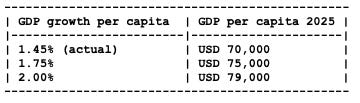
Steve Hou looks at the data and points out through electrification, mass production, the interstate highway system, multi-modal logistics and digitization, the US has had a central tendency toward 2 percent per capita GDP growth per annum. Maybe AI is just the next innovation that keeps the country getting richer as the same pace as it always has.
For obvious reasons Hou uses a log scale, diminishing the visual impact of small deviations from the trendline. In 2000, US GDP per capita was about USD 49,000 in 2025 dollars, compared to about USD 70,000 today — or about a 1.45 percent CAGR. Even small improvements in productivity would have had a measurable impact in how Americans live today.
Back in 2022, when I gave a presentation to a few dozen CIOs, one of them asked me whether I thought US aid for Ukraine might result in a destructive cyber-attack that turns off the lights in New York. I noted as a point of undisputed fact that the lights were still on in Kyiv. I also noted that deterrence applies to cyberattacks no less than it does to kinetic attacks.
Since then, cyberattacks have disrupted the Ukrainian electrical grid, but now nowhere near as much as missile, drone and artillery attacks.
I wont go so far as Thomas Ryd in saying that cyberwar is a chimera, but I’ve typically encouraged CIOs, CTOs and CISOs to take a measured view on the risk of destructive, state-sponsored cyberattacks.
Of course, none of us can say with precision what impact the combination of increasing geopolitical tension, AI and quantum computing will have on cybersecurity risk for large enterprises
Yes, it’s good that Mark Lynd create some visibility about this question with his novel “Cyber War: One Scenario.” But still the book is a missed opportunity. It could have illustrated a bunch of complicated, thorny issues — like choices between air-gapping and segmentation. Instead he mostly depicts people telling each other about the most recent tragedies and lamenting that they didn’t spend more money to prevent them. It warns, but does not illuminate.
Love the wisdom here! Great for people in their early careers
Thanks for sharing the stories. The insights are definitely more Valuable than thousands of words from a LLM generated prose