

Happy Thanksgiving — and welcome to the second issue of Prosaic Times.
The newsletter exists because understanding enterprise technology takes strategy, economics, history, psychology — and a stubborn refusal to accept the way things are is the way they have to be. (As a note, I am still very much with McKinsey.)
This issue examines the tension between the wonder and the frustration of enterprise technology:
From the backlog: a description of how The Brown Daily Herald showed me how savvy use of technology assets got us all to sleep earlier and why enterprise technology is maddeningly difficult.
The main argument: GenAI wont throw knowledge workers out on the street, but will create more demand for knowledge work, definitely in the enterprise, possibly in the university
The CIO’s desk: How to defend against the vibes and explain that you don’t need to repatriate your applications from the cloud
What I’m reading, watching and listing to: a report from the UK on change control; change is neither glamorous not easy, but enterprise technology doesn’t run well unless you get it right
Articles from the backlog
I’ve updated some of the more relevant pieces I’ve published on LinkedIn and moved them over to Substack. Here’s a few you might find interesting:
The first thing I ever fixed (in case you didn’t get the first issue)
Why you run out of brain before you run out of day -- and what to do about it
What's the deal with the otters? (Because I know you’ve been asking)
When I wasn’t allowed to query systems older than I was (because I very possibly might have been the original confused consultant back in the day)
The main argument: Yes, the Jevons paradox applies to knowledge work
Only about twice per week does someone express amazement that a former history major could be a passionate technologist professionally. It’s always made sense to me. History helps us understand technology, and technology drives history.

What times we live in, at least if you want to know about the world. Yes, GenAI creates risks, both in the university and in the enterprise – but it also allows us to know more things and know them more confidently and precisely. Traditional machine learning was great at narrow optimization, but it couldn’t touch the messy, high-stakes decisions requiring human judgment — GenAI can. For enterprises, GenAI will accelerate insight generation, pushing organizations to operate at a faster tempo. For universities, it raises the bar for research and unlocks sources of insight that were previously unreachable. The Jevons paradox doesn’t just apply to compute, it also applies to human intellect and creativity.
Why GenAI is so interesting
I didn’t find machine learning especially interesting the first time I saw a demo. I said to myself, “Hmmm. They’re probably doing a gazillion multiple regressions and then using some sort of champion-challenger model to evolve the algorithm to optimize the dependent variable. I guess that’s pretty cool.” ChatGPT has since explained to me that my assessment was a bit of an over-simplification, but not fundamentally incorrect.
But machine learning seemed very relevant in some applications and not relevant at all in many, many other applications. It excels at optimization where you need to optimize one or a few variables, and where you have at least pretty good quantitative data – algorithmic trading, B2C pricing, auto insurance underwriting, product scheduling. All massively accretive.
But I’m not sure any traditional machine learning model could have helped Eisenhower determine whether to postpone overlord in the face of uncertain weather. Or Kennedy in deciding whether to blockade or quarantine Cuba. Or whether Churchill should have returned the UK to the gold standard in the 1920s. Or whether AMZN should have built AWS. Or whether Tesla should have built factories in the PRC. Too many variables. Too much uncertainty. Too many intangibles. Not enough data.
Even the most interesting enterprise technology decisions (e.g. where to use cloud, whether to re-platform an application, when to migrate to a new #ERP platform and how) may not reach those stakes – but they do have some of the same complexities – many variables, dynamic behavior by other actors in the system, etc. Luttwak would tell us (and we should all listen to Luttwak) that traditional machine learning follows the linear, cumulative and intuitive logic of tactical and operational effectiveness. But the most important decisions, the bet-your-career decisions, follow the non-linear and counter-intuitive logic of strategy.
I was also skeptical large language models when GPT-3.5 first burst into public consciousness late in 2022. Enterprise technologists must be skeptics. #RPA turned out to be a disappointment. Distributed ledgers are the technology of the future, and may always be. Low-code/no-code hadn’t set the world on fire, and most companies hadn’t done much with AR/VR. Lots of things like good in demos, and just don’t work in the enterprise. As I like to say, technology is easy. Technology with an ROI is hard. Technology with an ROI at scale, with compliance, with security and with resilience is brutal. Some developed a software program that could write haikus and sonnets. We don’t write many haikus and sonnets at work. Even oddballs like me don’t do this. Rodney Zemmel wrote a poem about product operating models once, but I think that’s an edge case. Yes, it could also write emails, but did anyone thing the world needed more and longer emails?
Of course, I got over my initial cynicism, as I learned more about LLMs and as labs released reasoning models and deep research offerings. (As a note, I think I can conceptually understand how a LLM works – my brain stalls when I try to get my head around reasoning models.) GenAI can process text and ideas, not just numbers or highly structured data. (And let’s face it, traditional technology can match and count instances of structured text – it can’t understand it.) This allows it to:
Accept textual commands from a user who hasn’t learned a precise set of semantics – which is great because GUIs are horrible
Widen the happy path when automating processes involved complicated data – like almost any sort of B2B transaction
Convert unstructured data to structured data
I wonder of the last of these dwarfs the other two in import, because it allows us to know much more about the world. And knowing more about the world is everything – it’s the difference between a modern, industrialized economy and the world of 1750. I wouldn’t have enjoyed living in 1750. Combined with sober judgment, it’s the difference between making winning and losing high stakes decisions.
Why GenAI may be good for white collar work in the enterpsie
All this is no less exciting and revolutionary for the enterprise as it is for the university. Most corporations are just as much in the knowledge production and dissemination business as any university – companies just hope that the knowledge it produces is less esoteric and more applicable than, say, the evolution of the sonnet in Tudor England. On good days that’s true. Obviously, there is much insight we can derive from the text in business cases, Jira tickets, architecture documents, etc. Hell, how much insight could we derive from the email or slack trail about a major program if we could get at it. And I will admit: I haven’t even begun to think about how we could use Deep Research to access public information that might inform enterprise technology decisions.
Naturally, this will dramatically reshape work life for the entire professional-managerial class (PMC). The past thirty years have been a boom-time for the PMC, enabled by technology innovation and public policy change – interesting both regulation and deregulation have increased the demand for what Robert Reich termed “symbolic analysts” decades ago. The rhetoric and reaction is interesting:
Ford CEO Jim Farley says AI will wipe out half of white collar jobs: https://www.wsj.com/tech/ai/ai-white-collar-job-loss-b9856259?st=G8KU4C&reflink=article_email_share
Slightly more than half employees are worried at AI in the workplace; only about one-third are excited or hopeful: https://www.pewresearch.org/social-trends/2025/02/25/workers-views-of-ai-use-in-the-workplace
Others are more sanguine:
The US Treasure Department predicts that GenAI may increase demand for higher-skilled white collar jobs (https://home.treasury.gov/news/press-releases/jy2760?utm_source=chatgpt.com)
Erik Brynjolfsson argues that GenAI will augment white collar workers rather than replace them (https://siepr.stanford.edu/news/generative-ai-boost-can-boost-productivity-without-replacing-workers?utm_source=chatgpt.com)
And of course McKinsey & Company is on the record in writing that GenAI could expand white collar employment (https://www.mckinsey.com/mgi/our-research/generative-ai-and-the-future-of-work-in-america)
How could this be? Maybe Jevon’s paradox applies to labor as well as compute. Let’s take an auto company as an example. A new (or refreshed) car model costs billions in product management, design, product engineering, industrial engineering and marketing white collar labor. If you cut 30 percent of the labor out of developing a new car, would an auto company just drop the reduced costs to the bottom line? Or would customers demand a wider variety of more innovative products? Put another way, how much of the value from GenAI will companies capture, and how much will they compete away as consumer surplus? Let’s take an enterprise technology example: software engineering talent is the rate-limiting factor in much business innovation. Even when companies could afford more software engineers, they couldn’t always find them. So will companies always use enhanced software engineering productivity to cut IT costs – or will they use it to accelerate digitization and automation?
In the Financial Times, Salesforce CEO Marc Benioff writes: “History tells us something important here. From the printing press to the personal computer, innovation has transformed the nature of work — and in the long run created more of it. AI is already generating new kinds of roles. Our responsibility is to guide this transition: by breaking jobs down into skills, mapping those skills to the roles of the future, and helping people move into work that’s more meaningful and fulfilling.” (https://www.ft.com/content/3db52a71-7660-405d-9e5e-42a97d2d64ca?segmentId=b385c2ad-87ed-d8ff-aaec-0f8435cd42d9)
Quite so. As technologists, we have our task in front of us – let’s attack it. Some members of the executive team may think of IT as the back office – I would argue that technologists are doing some of the most interesting and exciting work in the business world right now.
Why GenAI should be good for the university (even if it might not be)
I caught up with a senior academic last week about several things and we had a good discussion about the intersection technology innovation and knowing things.. She mentioned that most of the humanities faculty fear GenAI and just wished it would go away. Both because of AI-enabled cheating and because of diminished learning. MIT researchers found that students who relied on GenAI to write papers retained much less of what they wrote about. (https://arxiv.org/abs/2506.08872?utm_source=chatgpt.com). Historian Niall Ferguson (yes, he’s become a bit of a pundit, but you really should read “The Pity of War” if you are interested in WW1) probably has the steelman case here – he argues that universities should create a “cloister” where students spend several hours a day with access to no technology more modern than paper books. (What, no Kindle???)
And yet: the works of Homer and the Torah existed for centuries before being committed to paper. We can imagine a Greek bard complaining about the young ‘uns read the Illiad, rather than memorizing it. Nearly fifteen years ago Nicholas Carr (yes, that Nicholas Carr, the one who is wrong about everything) produced a book called “The Shallows: What the Internet Is Doing to Our Brains,” arguing that using the Internet promotes superficial thinking, weakens memory consolidation and reduces our capacity for attention. Of course, many get addicted to TikTok, but others download papers from arxiv.org! Fellow otter enthusiast and Wharton professor Ethan Mollick made exactly this point in his Substack piece “Against ‘Brain Damage.”
I made the point to this academic that students using GenAI to research papers is a good thing, not a bad one. I used the example of the “Silos to Systems Thinking” report we are working on. If the team told me they weren’t using ChatGPT in their research, I would look at them like they had three heads. My expectations for the report are much higher than they would have been if we didn’t have access to Deep Research. I suggested that humanities professors should encourage students use GenAI in writing their papers, but also tell them that the bar is much higher than it used to be. The bar for research papers should have been higher in an era of Google and word processors then when students composed papers on typewriters using the information they could find in the library. She thought this was interesting.
I further suggested that GenAI could lead to a revolution in the social sciences and the humanities because it could massively expand the data academics could analyze. What if you were a historian of the American family and you could track how divorce evolved by interrogating the records from every divorce case in New York State over the course of the twentieth century? What you were a business historian and you could categorize all the articles of incorporate for every company in early nineteenth century England? Many would have been disappointed if I didn’t mentioned knowledge graphs, so I pointed out once you had this data, you could use knowledge graphs to organize it – and you could even link propositions to supporting propositions and eventually supporting data.
And you are starting to see a few examples of GenAI enabling fascinating things in social sciences.
Yale economics professor José-Antonio Espín-Sánchez processed volumes of contracts and passenger listings to map relationships among migrants from Spain to America over centuries
Political science professor Kevin Deluca used ChatGPT to analyze historical newspaper endorsements. (For our younger readers, there were these things in every city that you subscribed to…oh, never mind.)
Sociology professor Emma Zang used GenAI to decode 1.5 million legal judgments in the PRC to assess how a 2011 law affected gender inequality in divorce cases
As reasoning models develop, they may even be able to interrogate academic research for false premises and other logical flaws (https://arxiv.org/abs/2503.23363), and it looks like faulty reasoning is endemic in some humanities and social sciences departments.
The CIO’s desk: No, big banks are not repatriating swaths of applications from the cloud
About a year ago, Barclays published research saying that 83 percent of workloads back to private cloud from public cloud. At that point, everyone and his/her cat has asked me about this slide, which is bouncing around Twitter. (I don’t have a cat. I wish I had a cat, but my wife is deathly allergic. Also, she worries that shuttling back and forth between NYC and RI would be traumatic for the cat. Reasonable point.)
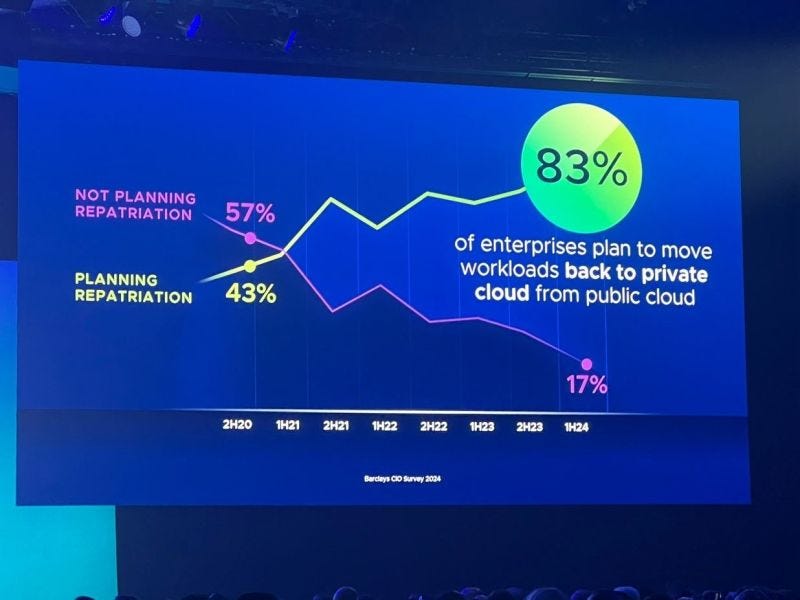
Cloud migration is tough and expensive. For almost all workloads, a system will work better in the cloud, if appropriately architected. “Appropriately architected” does a lot of work in that sentence, and we know that many companies skimped on remediation and did a lot of “lift-and-shift,” which is not correlated with appropriately architected for the cloud.
This could be as much an indicator of cloud penetration as cloud failure -- if you haven’t migrated anything, you don’t have anything to repatriate. The slide only refers to _companies_ considering repatriation. So if you migrated 500 workloads and might repatriate 5, you would count as one of the potential CIOs planning repatriation!
What you say to your CEO if he or she asks about this
Here’s what you say when somebody who doesn’t know any better calls you up and frantically says the G-SIBs are repatriating applications from the cloud so we should too!
1. Yes the on-premise vendors are correct when they tell you that big banks are repatriating applications from the cloud.
2. Notice that the vendors never say _how many_ or _what percentage_ of applications are being repatriated.
3. Big banks spend billions of dollars managing several thousands applications. At that scale pretty much any pattern you can imagine happens a few times
a few applications that are lifted and shifted would up costing a lot in the cloud driving a decision to repatriate? Yep it happens
migration back and forth between database types? Sure!
hell at that scale there are probably a few applications struggling because the relevant architect quit IT to become a professional juggler or bagpiper? Sure!
4. Just because something happens a few times doesn’t make it a strategic direction. Anecdata is just as dangerous as it always was!
5. Yes, cloud adoption is slower than everyone thought. Not because of repatriation, but because the remediation required for migration is time consuming and expensive. You can reduce time and cost by, say, 1/3 via GenAI — if you’re willing to invest in tooling.
6. You could also note that you don’t want to repatriate applications because otters are attacking your on-pre data center and they will cause havoc if they get at the cabling inside. But that might be gilding the lily.

What I am reading, watching and listening to
Why Great Powers Sleepwalk to War — A Masterclass with Hugh White
Famous strategist talks about 11 books on strategy that have influenced him the most. Catnip, no?
The guest offers an interestingly mixed list. Of course, everyone has to read “Diplomacy” by Henry Kissinger and “The Rise and Fall of Great Powers” by Paul Kennedy. “The Rise and Fall of British Naval Master” is also pretty awesome. E.H. Carr and A.J.P Taylor are a little, er, too revisionist for my taste. And Niall Ferguson and David Fromkin pretty much demolished Barbara Tuchman’s thesis on the origins of the Great War
White’s discussion of Donald Kagan’s book “The Outbreak of the Peloponnesioan War” is most interesting.
Kagan argues that that the Peloponnesian War was contingent, rather than inevitable, that prudent leaders can navigate away from destructive conflict. Good advice for those of us who’ve occasionally gotten into conflict with a colleague and wondered afterwards “what the hell was I try to achieve here, again?”
White also raises Graham Allison’s book “Destined for War.” One note on that: one of Allison’s scenarios for war (an attack that compromises the integrity of consumer banking records) would play out very differently because of Sheltered Harbor. I will share my recollections on Sheltered Harbor and how it contributes to the resiliency of the US financial system against cyber-attack in a future issue.
Implementing Technology Change
General Pershing may or may not have said “Amateurs study strategy; professionals study logistics” — but in IT operations we know professionals study change control. How much risk and instability comes from poorly implemented changes? So plaudits to the UK’s Financial Conduct Authority for publishing a detailed review of change management practices. Even though they don’t seem to have updated it since 2021, I think many of the findings still hold:
Drivers of operational disruption from change activity are unsurprising: lack of visibility into third party changes, manual change review, legacy technology, major (rather than smaller) changes
Average failure rate of 3.8 percent for major changes, compared to 1.6 percent for all changes
Change advisory boards accepted 93 percent of changes — some didn’t reject any at all
Emergency changes on 3-5 percent of all changes on average
Maintenance and upkeep and regulator mandates more than half of all changes
About one-third of firms could support weekly or daily change velocity'
Thanks for reading — see you next week!
Very much enjoying your pontifications. Because I have lost my ability for critical thinking, I asked Chapt GPT to evaluate your conclusion that Jevons’ paradox applies to labor as well as compute. Good news- per ChapGPT “Jevons’ dynamic absolutely applies in many knowledge-work domains”. Eric (Disclaimer- all opinions expressed are ChatGPT)
Absolutely fascinating👏