

Enterprise technology stands as the intersection of wonder and frustration.
In 1968, United States equity markets closed on Wednesday for several months because brokerage back offices could not keep up with unprecedented volumes of about 24 million shares per day.[1] Today, dozens of exchanges process 15 billion transactions daily.[2] Yet the same brokerages that used automation to scale volumes by two orders of magnitude today require months to onboard new institutional customers, as requests wend their way through dozens of poorly creak and poorly integrated technology systems.
In 1963 Pan-American Airways built its headquarters in midtown Manhattan so passengers could pick up tickets in the first-floor sales office.[3] As recently as the turn of the century, businesses had on-site travel agents to print out paper airline tickets for traveling executives. By 2008, all airline tickets were electronic.[4] Yet the same airlines that today rely on mobile boarding passes for more than half of all trips frequently strand angry passengers when buggy and outdated flight or crew scheduling systems crash.[5]
Businesspeople older than 40 can remember when working from home meant patiently downloading email over a phone line at 56Kpbs. When a global pandemic relegated tens of millions to working from home at the same time, they learned about high quality videoconferencing and accessed corporate systems from the spare bedroom, without any reduction in productivity.[6] Yet slow, unstable, and confusing systems still bedevil corporate workers. One study found that people spend 11 percent of their computing time in a state of frustration.[7]
The technology officers who manage thousands of systems for large enterprises are either wizards or dunces, depending on the day you ask the question and the business process you look at when you do.
CFOs and economists probably have a range of opinions on tech officer effectiveness, but many of them have questions about the ROI and economic impact of enterprise technology investments.
CFOs see explosive demand for technology capabilities — digital customer experiences, automated processes, technology-enabled offerings and sophisticated analytics. Yet exciting business cases showing massive Net Present Value (NPVs) and rapid paybacks somehow fail to translate into overall business performance.
Economists are even more uncertain. In 1987, Nobel Laureate Robert Solow formulated his productivity paradox: “You can see the computer age everywhere but in the productivity statistics.”[10] A few years later Erik Brynjolfsson reviewed the major literature—yes, productivity improvement had been disappointing in the 1980s as companies invested more in automation, but many other factors including labor force composition, energy costs, regulatory burden and the shift to a services-based economy might have swamped the impact of technology investments. A review of sector-level studies in manufacturing and services sectors demonstrated highly variable conclusions and endless methodological uncertainty.[11]
The 1990s brought more encouraging news, if only for a time. Starting in 1995, output per hour started to grow much more quickly than it had over the previous two decades—and Federal Reserve economists attributed the improvement to corporate investment in information technology. This positivity continued even after the 2000 dotcom crash.[12]
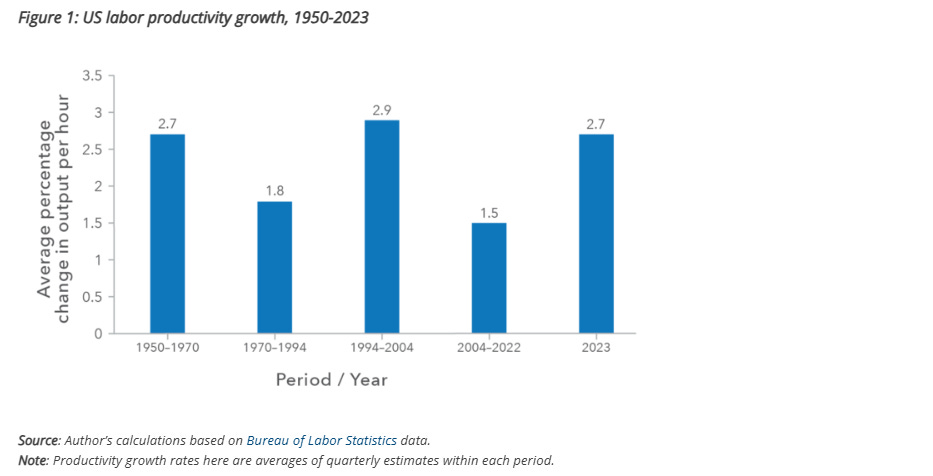
The story gets less encouraging around 2005. By 2018, the McKinsey Quarterly asked, “Is the Solow Paradox back?” noting that adoption barriers and transition costs meant that only a modest fraction of corporate processes had been digitized.[13] At the time, Brynjolfsson suggested the United States was experiencing “a replay of the 1980s,” in that corporations had not yet figured out how to metabolize and monetize the recent technology innovations.[14] Most recently, some commentators have started to ask if monetization may now be at hand[15] after productivity growth in the United States increased to 2.7 percent per annum in 2023, compared to an average of 1.5 percent from 2004 to 2022.[16] Labor productivity grew by at least 2 percent year-on-year compared to the same quarter twice in the five years preceding the pandemic—productivity has now increased by at least that rate for five quarters in a row.[17] Of course, not everyone is so optimistic. Longtime technology skeptic and Northwestern University economist Robert Gordon has dismissed AI as incremental, especially compared to the massive investments in physical infrastructure that transformed the American economy and standard of living in the middle decades of the last century.[18]
Maybe Solow’s paradox requires more nuance. Technology investments improve productivity and contribute economic value, but not in all periods and not as much as they should – the heated nature of economists’ conceptual and methodological debates here highlight the boundaries of technology’s impact. Why is this? Even if nobody knows when William Gibson said “The future is already here. It’s just not evenly distributed yet”[19] the point still applies to getting value from technology.[KE4] [JK5]
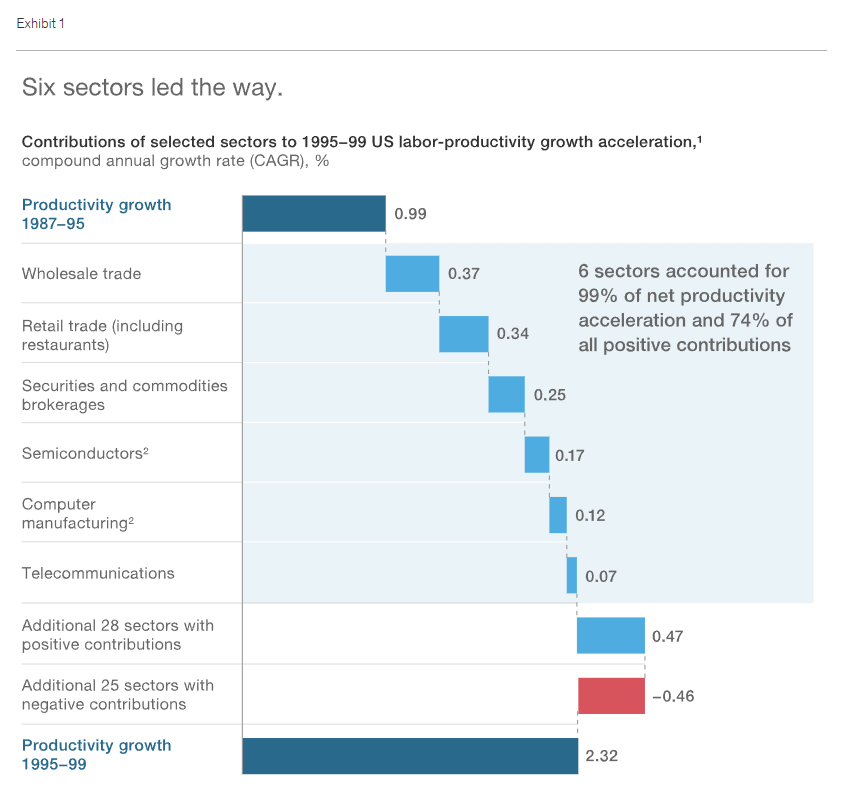
Only a small fraction of the US economy drove the 1990s productivity boom. The sectors of wholesale trade, retail trade, security brokerage, semiconductors, computer manufacturing, and telecommunications made up three-quarters of productivity growth. In aggregate, the other 53 economic subsectors were a wash, combining for zero net productivity growth. [20]
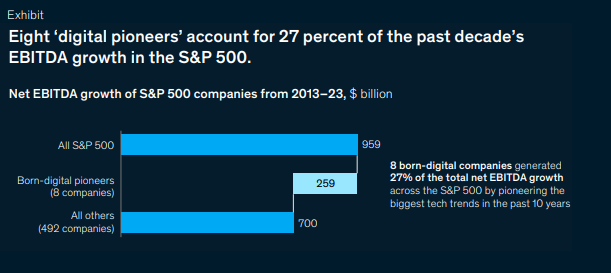
In recent years, this dynamic looks like it has become only more pronounced. In aggregate, the S&P 500 increased total EBITDA by $959 billion from 2013 to 2023. Eight born-digital companies generated more than a quarter of that increase and increased their market[JK6] [JK7] [PP8] capitalization by $7.9 trillion[RC9] , compared to a $19.0 trillion increase for the other 492 companies in the index.[21],[22]
These companies succeeded because they built cutting-edge technology capabilities that enabled them to collect unprecedented information about their customers, introduce innovative products quickly, scale to massive volumes at low cost and make business decisions based on quantitative insights. For the most part, the other 492 companies in the S&P 500 did not.
In short, established enterprises experience too little of the wonder of technology and too much of the frustration. This poses an existential challenge for technology officers—and their compatriots across the management team. Unless companies can solve the conundrum of enterprise tech, they will struggle for relevance in commercial and capital markets as “born digital” companies hive off ever more of the attractive slices of advanced economies.
[1] Wells W. Certificates and Computers: The Remaking of Wall Street, 1967 to 1971. Business History Review. 2000;74(2):193-235. doi:10.2307/3116692
[2] https://www.cboe.com/us/equities/market_share/
[3] Gandt, Robert, Sky Gods: The Fall of Pan Am, Chapter 6
[4] CNN.com, Final Call for Paper Boarding Passes? September 2, 2023
[5] MSBC.com, What to know about airline refunds, delays as global IT outage causes ‘mass chaos,’ expert says, July 19, 2024
[6] Pabilonia, Sabrina and Redmond, Jill, “The rise in remote work since the pandemic and its impact on productivity,” US Bureau of Labor Statistics, October 2024
[7] Herzten, Morten and Hornbaek, Kasper, “Frustration: Still a Common User Experience,” ACM Transactions on Computer-Human Interaction, vol. 30 (2023), no. 3 article 42
[8] “Jeff Bezos’ Risky Bet,” Bloomberg BusinessWeek, August 2006
[9] Arora, Chhavi, Will Forrest, Mark Gu and James Kaplan, “In Search of cloud value: Can generative AI transform cloud ROI?” McKinsey & Company, November 15, 2023
[10] Triplett, Jack, “The Solow Productivity Paradox: What Do Computers Do to Productivity?” The Brookings Institution, March 1, 1999
[11] Brynjolfsson, Erik, “The Productivity Paradox of Information Technology: Review and Assessment,” Communications of the ACM, December, 1993
[12] Oliner, Stephen and Sichel, Daniel, “Information Technology and Productivity: Where Are We Now and Where are We Going,” The Federal Reserve Board, May 10, 2002
[13] Krishnan, Mekala, Jan Mischke and Janna Remes, “Is the Solow Paradox back?” The McKinsey Quarterly, June 4, 2018
[14] Rotman, David, “The productivity paradox: Why brilliant AI technologies are not leading to
[15] Smialek, Jenna, “Are We in a Productivity Boom? For Clues, Look to 1994,” The New York Times, February 21, 2024
[16] Pardue, Luke “In Brief: The Recent Rise in US Labor Productivity,” The Aspen Institute, April 24, 2024
[17] Lahart, Justin and Lauren Weber, “The American Worker is Becoming More Productive,” The Wall Street Journal, January 2, 2025
[18] Gordon, Robert, “Will Robots and AI Revolutionize Productivity Growth?” Northwestern University and NBER Global AI and Economy Conference, Tokyo , March 1, 2021
[19] Kennedy, Patrick, “William Gibson’s Future Is Now,” The New York Times, January 13, 2012
[20] Lewis, William, Vincent Palmade, Baudoin Regout and Allen Webb, “What’s Right with the US Economy,” The McKinsey Quarterly, February 1, 2002
[21] Arora, Chhavi, Will Forrest, Mark Gu and James Kaplan, “In Search of cloud value: Can generative AI transform cloud ROI?” McKinsey & Company, November 15, 2023
[22] McKinsey Value Intelligence Platform, S&P Global Market Intelligence, 2013-2023 analysis of Amazon, Apple, Adobe, Alphabet, Meta, Netflix, NVIDIA, Salesforce